

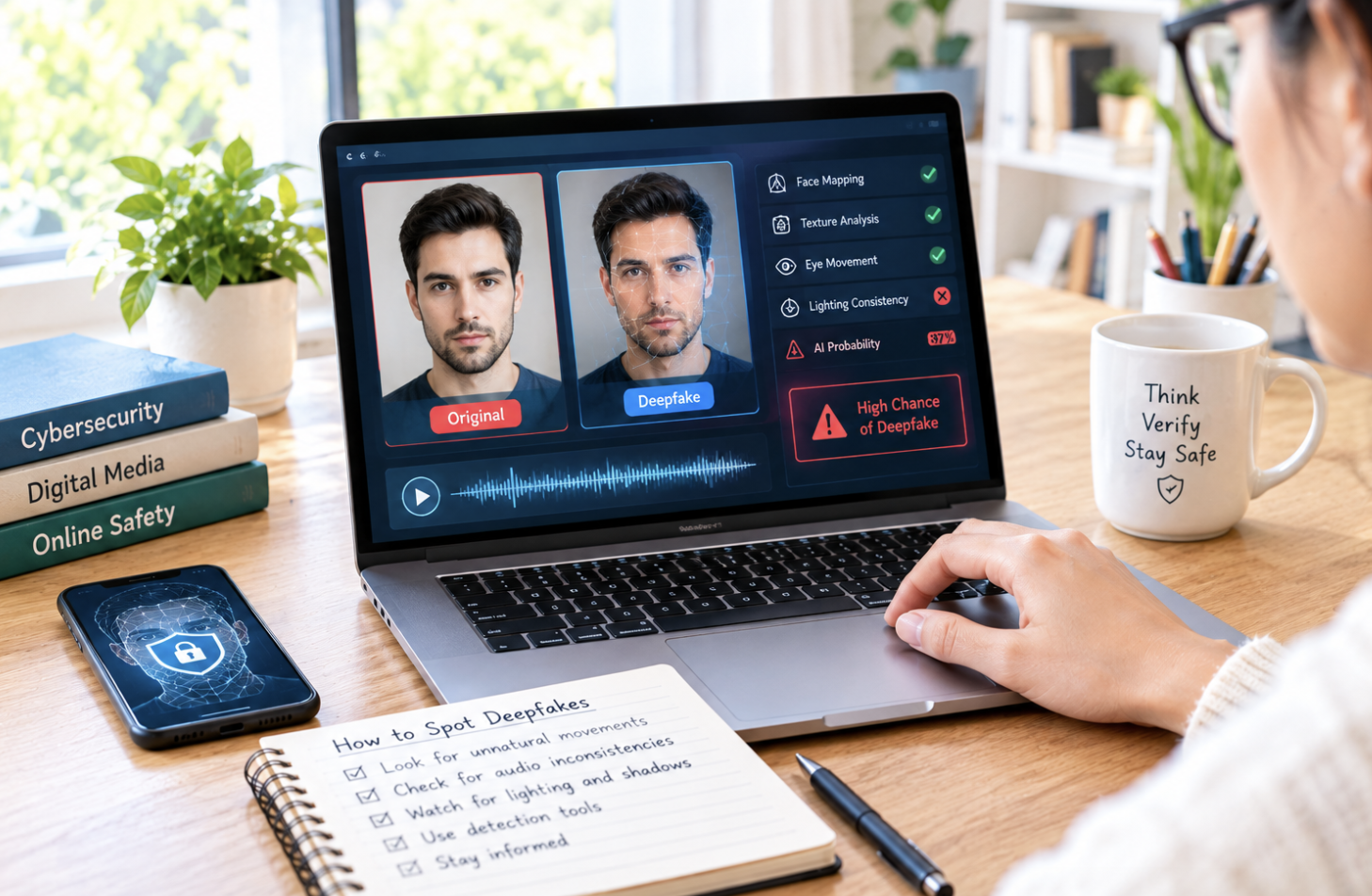
A finance employee received what appeared to be a video call from her company’s chief executive, instructing an urgent wire transfer for a confidential acquisition. The voice, mannerisms, and even facial expressions matched perfectly. It was entirely fake, generated by increasingly sophisticated deepfake technology, and the company nearly lost a significant sum before a colleague’s scepticism prevented the transfer. This article explains how deepfakes work and how they’re detected.
What Deepfake Technology Does
Deepfake technology uses machine learning to generate convincing fake video, audio, or images of real people saying or doing things they never said or did, trained on existing footage and audio of the target person to learn their specific mannerisms, voice patterns, and facial movements. What once required expensive, specialised equipment and expertise has become increasingly accessible through widely available software.
How Deepfake Generation Technology Works
- Machine learning models analyse extensive footage of a target person
- The system learns to replicate specific facial expressions, voice patterns, and mannerisms
- New content is generated by mapping these learned patterns onto a different source video or audio
- Increasingly sophisticated models produce results that are difficult to distinguish from authentic footage
The Range of Risks Deepfakes Pose
- Financial fraud through impersonation of executives or trusted contacts
- Political disinformation designed to damage a candidate’s reputation
- Non-consensual explicit content created using someone’s likeness without permission
- Erosion of general public trust in authentic video and audio evidence
How Detection Technology Is Trying to Keep Pace
Researchers have developed detection tools that analyse subtle inconsistencies in deepfake content, including unnatural blinking patterns, inconsistent lighting, and audio-visual synchronisation issues that human eyes might miss but automated analysis can identify. This has become an ongoing technical arms race, with detection methods and generation techniques each advancing in response to the other’s improvements.
Why Detecting Deepfakes Is Becoming Increasingly Difficult
As generation technology has improved, the telltale signs that once made deepfakes relatively easy to spot, like unnatural eye movement or blurred edges, have become harder to detect, even for specialised software. This escalating difficulty has prompted growing interest in authentication approaches that verify content is at the point of creation, rather than relying entirely on after-the-fact detection.
How Organisations Are Building Verification Into Content Creation
Some technology companies and media organisations have begun implementing content authentication standards that embed verifiable metadata into footage at the moment of capture, creating a tamper-evident record that can help distinguish authentic content from later manipulation. This approach shifts some of the verification burden toward proving authenticity rather than solely trying to detect fakery after the fact.
Practical Steps Individuals and Businesses Can Take
- Establish verification protocols for high-stakes requests like wire transfers, regardless of apparent video or voice confirmation
- Be sceptical of urgent, unusual requests, even from seemingly familiar sources
- Stay informed about deepfake detection resources and warning signs
- Support media literacy efforts that help the public critically evaluate video content
How Deepfake Awareness Campaigns Are Educating the Public
Recognising that technical detection alone won’t solve the deepfake problem, various organisations have launched public awareness campaigns specifically designed to help ordinary people recognise warning signs and adopt healthy scepticism toward unverified video and audio content circulating online. These educational efforts have become increasingly important as deepfake technology has grown more accessible to a wider range of people beyond specialised researchers and malicious actors with technical expertise.
The Role of Legislation in Addressing Deepfake Harms
Lawmakers in various jurisdictions have introduced legislation specifically targeting harmful deepfake uses, though crafting effective laws has proven challenging given the need to balance addressing harms against protecting legitimate uses of similar technology, such as satire, film production, and other creative or educational applications. This legislative balancing act continues to evolve as courts and lawmakers grapple with cases that test the boundaries of these relatively new laws.
How Social Media Platforms Are Responding to Deepfake Content
Major social media platforms have implemented policies specifically addressing deepfake content, ranging from labelling requirements that flag manipulated media to outright removal of harmful deepfakes, though enforcement consistency across the massive volume of content uploaded daily remains a persistent challenge. Platforms continue refining their detection systems and policies as deepfake technology evolves, though critics argue enforcement often lags behind the pace of technological advancement.
How Deepfake Technology Intersects With Entertainment Production
Beyond its harmful applications, deepfake-adjacent technology has found legitimate uses within film and entertainment production, including de-ageing actors for flashback scenes or recreating a deceased actor’s likeness for a specific project with appropriate estate permission and oversight. This legitimate creative use illustrates the dual-use nature of the underlying technology, complicating efforts to regulate it without also restricting valid artistic and entertainment applications.
Building Organisational Resilience Against Deepfake Fraud
Beyond individual scepticism, organisations increasingly build formal resilience against deepfake-enabled fraud into their standard operating procedures, including mandatory multi-person approval for high-value transactions and established callback verification protocols that don’t rely on the same communication channel used for the original suspicious request. Organisations that have implemented these structural safeguards report successfully catching several attempted deepfake-based fraud incidents before any actual financial loss occurred.
How Deepfake Technology Has Affected Political Campaigns Specifically
Political campaigns have faced growing concern about deepfake content specifically timed to spread during critical pre-election periods, when there’s limited time for fact-checking and correction to reach voters before an election takes place. Several countries have introduced specific regulations addressing political deepfakes, requiring clear labelling or outright prohibiting certain uses close to an election, reflecting the high stakes this application carries for democratic processes.
How Insurance Companies Are Responding to Deepfake Fraud Risk
Insurance companies offering cyber liability and fraud coverage have begun specifically addressing deepfake-enabled fraud within their policies, recognising it as a distinct and growing risk category separate from more traditional forms of cyber fraud like phishing emails. This evolution in insurance products reflects the broader business world’s growing recognition that deepfake fraud represents a material financial risk requiring specific attention rather than being treated as a mere theoretical concern.
How Media Literacy Education Is Adapting to the Deepfake Era
Educational institutions have begun incorporating media literacy content specifically addressing deepfakes and synthetic media into broader digital literacy curricula, recognising that traditional media literacy education focused primarily on identifying biased reporting doesn’t fully prepare students for a media environment where video and audio evidence itself can be entirely fabricated. This curriculum evolution reflects a broader recognition that critical media evaluation skills need continuous updating as manipulation technology continues advancing.
How the Deepfake Detection Industry Has Commercialised
The growing threat of deepfake fraud and disinformation has spawned a substantial commercial industry offering detection and verification services to businesses, media organisations, and government agencies concerned about this risk. This commercialisation reflects the scale of investment now flowing into addressing the deepfake problem, though the ongoing technical arms race between detection and generation technology means no commercial solution currently offers a complete, permanent fix.
How Deepfake Technology Has Affected Journalism and Fact-Checking
News organisations have had to adapt their verification processes considering deepfake technology, developing more rigorous protocols for verifying video and audio evidence before publication, for footage submitted by anonymous or unverified sources. This adaptation represents a significant shift in journalistic practice, requiring news organisations to invest in specialised verification expertise that simply wasn’t necessary before sophisticated synthetic media became a realistic possibility for fabricating convincing false evidence.
How Voice Cloning Technology Specifically Has Advanced
Voice cloning technology, a specific category of deepfake technology focused purely on audio rather than video, has advanced to the point where convincing voice replication now requires only a small sample of someone’s actual speech, raising particular concern for phone-based fraud schemes targeting individuals and businesses alike. This specific advancement has prompted banks and other organisations handling sensitive phone-based transactions to reconsider voice-based identity verification methods that were previously considered reasonably secure.
How Deepfake Technology Has Affected Celebrity and Public Figure Rights
Public figures and celebrities have faced particular exposure to deepfake misuse, given the abundance of existing footage and images available to train convincing deepfake models of well-known individuals, prompting some jurisdictions to strengthen legal protections around unauthorised use of someone’s likeness. These evolving legal protections attempt to balance legitimate creative and satirical uses against the harm that convincing, unauthorised deepfakes of public figures can cause, both to the individuals themselves and to broader public trust in authentic media.
How Cybersecurity Training Programmes Have Adapted to Deepfake Threats
Corporate cybersecurity training programmes have increasingly incorporated deepfake awareness alongside traditional topics like phishing email recognition, reflecting organisations’ growing recognition that employee awareness represents a critical defence layer against this evolving fraud vector. Effective training programmes typically use realistic simulated examples specifically to help employees develop practical scepticism, rather than relying solely on abstract warnings that may not translate into improved real-world vigilance.
How Deepfake Awareness Differs Across Age Groups and Regions
Public awareness and concern about deepfake technology varies across different age groups and global regions, with younger, more digitally native populations generally showing greater baseline awareness of synthetic media risks than older populations less immersed in digital media consumption. This awareness gap has practical implications for targeted education efforts, suggesting a one-size-fits-all public awareness campaign may prove less effective than approaches tailored to different demographic groups’ existing baseline understanding.
How International Cooperation Addresses Cross-Border Deepfake Crime
Because deepfake-enabled fraud and disinformation often cross international borders, law enforcement agencies have increasingly recognised the need for cross-border cooperation frameworks specifically designed to address this category of crime, which can be more complex to prosecute than crimes committed entirely within a single jurisdiction. Building effective international cooperation mechanisms remains a work in progress, given the varied legal frameworks and levels of technical capability across different countries’ law enforcement systems.
How Deepfake Technology Has Prompted New Digital Consent Frameworks
The rise of deepfake technology has accelerated broader conversations about digital consent, specifically regarding whether and how someone’s likeness can be legitimately used to create synthetic media, even for seemingly benign or entertainment purposes. Some jurisdictions have begun developing more formal consent frameworks specifically addressing this question, recognising that existing likeness and privacy laws weren’t originally designed with sophisticated synthetic media generation in mind.
How Academic Institutions Study Deepfake Detection Methods
Universities and research institutions have established dedicated research programmes specifically focused on deepfake detection, often collaborating directly with technology companies to access the large datasets needed for training effective detection models. This academic research plays a crucial role in advancing detection capabilities that individual companies alone might not have sufficient incentive or resources to pursue as thoroughly on their own.
How Deepfake Risks Intersect With Elder Fraud Prevention
Older adults, already disproportionately targeted by various fraud schemes, face particular vulnerability to deepfake-enabled scams, such as a cloned voice of a family member requesting urgent financial help, given generally lower baseline familiarity with this relatively new technology. Fraud prevention organisations have begun specifically incorporating deepfake awareness into elder fraud prevention education, recognising this as an emerging and serious risk category requiring targeted outreach beyond general public awareness campaigns.
Deepfake Risks in Online Dating and Relationships
Deepfake technology has introduced new risks within online dating, including fabricated video verification intended to build false trust with a potential romantic scam victim, prompting some dating platforms to introduce enhanced identity verification features specifically to counter this emerging manipulation tactic.
Deepfake Risks Within Corporate Internal Communications
Beyond external fraud, organisations have grown concerned about deepfake risks within internal communications, such as fabricated video messages appearing to come from executives, prompting some companies to establish internal verification codes or protocols specifically for sensitive internal announcements.
Deepfake Awareness in Educational Assessment Integrity
Educational institutions have begun considering deepfake risks within remote assessment integrity, exploring identity verification methods that account for the theoretical possibility of synthetic media being used to circumvent standard remote proctoring and identity confirmation processes during online examinations.
Deepfake Risks in Insurance Claims Processing
Insurance companies have expressed growing concern about deepfake-manipulated evidence submitted during claims processing, prompting some insurers to invest in specialised verification technology specifically designed to detect manipulated photo and video evidence submitted as part of a fraudulent claim.
Deepfake Verification in Legal and Court Proceedings
Courts have begun grappling with how to properly verify video and audio evidence submitted during legal proceedings given deepfake technology’s existence, prompting some jurisdictions to develop specific evidentiary standards and expert verification requirements for digital media presented as part of formal legal cases.
Deepfake Concerns Within the Music Industry
Musicians and record labels have raised concerns about AI-generated deepfake audio mimicking a specific artist’s voice without permission, prompting industry discussions about appropriate consent frameworks and compensation models for this emerging use of voice cloning technology within music production.
Public Figures Proactively Registering Their Likeness
Some public figures have begun proactively registering distinctive vocal and facial characteristics with specialised services designed to help detect unauthorised deepfake use of their likeness, a defensive measure reflecting growing recognition among public figures that waiting for misuse to occur before responding often proves too late.
Final Thoughts
Deepfake technology has advanced from a novelty to a security and societal risk, capable of enabling sophisticated fraud and disinformation that can be difficult to detect even for trained observers. Staying informed about both the risks and the evolving verification tools designed to counter them has become an increasingly important part of navigating digital media responsibly.
Frequently Asked Questions
How can someone tell if a video is a deepfake?
Common warning signs include unnatural blinking, inconsistent lighting or shadows, and audio that doesn’t quite match lip movements, though increasingly sophisticated deepfakes can eliminate many of these telltale signs.
Is creating deepfake content illegal?
Laws vary by jurisdiction, with some countries and regions specifically criminalising certain deepfake uses, non-consensual explicit content and deepfakes intended to influence elections.
Can businesses protect themselves from deepfake-based fraud?
Yes, establishing verification protocols that don’t rely solely on video or voice confirmation for high-stakes decisions, such as requiring secondary confirmation through a separate channel, reduces this risk.
Are deepfake detection tools freely available to the public?
Some basic detection tools are publicly available, though the most sophisticated detection technology tends to remain with specialised organisations, researchers, and technology companies actively working on this problem.
How has deepfake technology affected trust in video evidence generally?
The growing sophistication of deepfakes has understandably increased public scepticism toward video and audio evidence generally, prompting new approaches to content authentication and verification.
Will deepfake detection ever fully keep pace with generation technology?
Experts remain divided, with many expecting this to remain an ongoing arms race indefinitely, which has driven growing interest in authentication-at-creation approaches rather than relying solely on after-the-fact detection.