

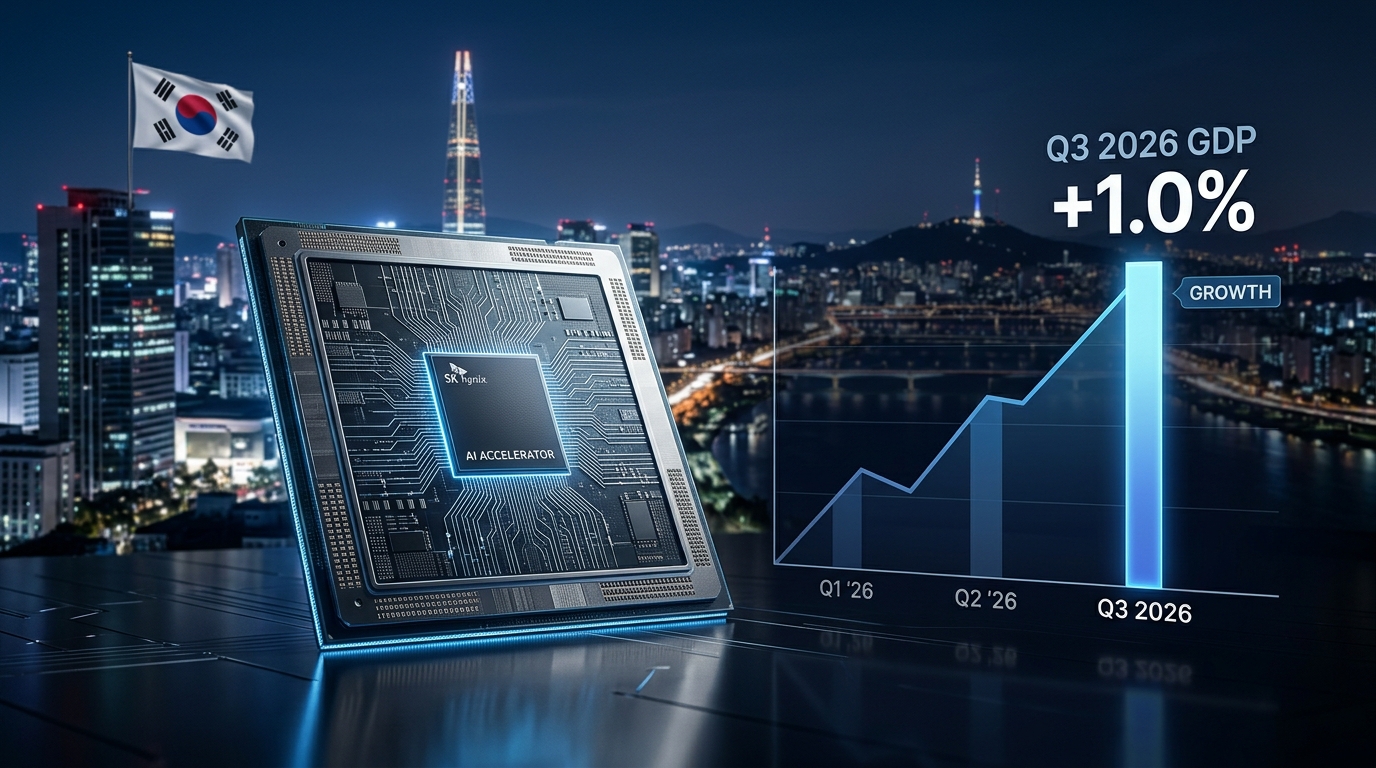
South Korea’s economy expanded more quickly than analysts had anticipated during the third quarter of 2026. Strong semiconductor exports and rising business investment supported the surprising expansion. The Bank of Korea reported that real gross domestic product (GDP) increased by 1% from the previous quarter. Meanwhile, annual growth reached 3.4%, according to its preliminary estimate.
The result exceeded economists’ expectations and improved the outlook for Asia’s fourth-largest economy. However, weaker household spending showed that economic growth remains uneven.
South Korea GDP Growth Exceeds Expectations
South Korea’s GDP increased by 1% between July and September 2026. This followed 0.6% growth during the second quarter. Economists surveyed by Reuters had expected quarterly growth of approximately 0.7%. Furthermore, the Bank of Korea’s August forecast anticipated only 0.3% growth.
The latest figures therefore highlighted stronger economic momentum than policymakers previously anticipated. However, the preliminary estimate may change when the central bank releases revised data.
South Korea’s economy has benefited from growing global demand for advanced technology. Growing investment in AI infrastructure has fueled stronger demand for semiconductors. This trend has strengthened exports and encouraged investment in production equipment.
AI Chip Demand Boosts South Korea’s Economy
The global AI boom has become a major driver of South Korea’s economic performance. Technology companies worldwide continue investing in data centers and AI computing infrastructure. Consequently, demand for advanced chips has supported South Korean manufacturers.
The semiconductor sector was responsible for about half of South Korea’s growth in the quarter. The Bank of Korea highlighted their significant contribution to the expansion.
South Korea hosts major semiconductor manufacturers that supply global technology markets. These companies benefit when AI developers require more powerful computing hardware. Moreover, increased demand can encourage manufacturers to expand capacity and upgrade production facilities.
However, the country’s reliance on semiconductor demand also creates risks. A slowdown in AI investment could weaken export growth. Similarly, falling chip prices could reduce manufacturers’ revenue and investment plans.
Semiconductor Exports and Business Investment Rise
Exports and facility investment provided important support during the third quarter. South Korean exports increased by 2.3% compared with the previous quarter. Strong demand for semiconductors, machinery, and electrical equipment supported this improvement.
At the same time, facility investment rose by 4.1%. Businesses increased spending on machinery, including semiconductor manufacturing equipment. Therefore, companies appeared willing to invest in expanding production capabilities.
These investments can support future economic activity through higher production capacity. They can also create opportunities for suppliers and related technology businesses. Nevertheless, the benefits depend on continued demand and efficient use of new equipment.
South Korea’s export performance has also remained strong throughout 2026. Exports exceeded $800 billion during the first nine months. This total surpassed the country’s previous full-year export record. This export momentum put South Korea within reach of the $1 trillion mark for the year.
Weak Consumer Spending Remains a Concern
Despite stronger economic growth, South Korean households continued facing spending pressures. Private consumption declined by 0.2% in the third quarter. This marked its first quarterly contraction in nearly four years.
Consumers reduced spending on goods and services, including cars, household appliances, and dining. Meanwhile, weaker financial market performance may have affected household confidence.
This creates a challenge for South Korea’s broader recovery. Strong exports can increase national income, but they do not automatically improve household spending. Therefore, domestic demand remains important for sustaining economic momentum.
Additionally, businesses serving local consumers may experience weaker sales despite improving export figures. A lasting recovery will require stronger household confidence and more balanced economic activity.
Construction and Government Spending Support Growth
South Korea also received support from construction and government spending. Construction investment increased by 0.7% during the third quarter. Meanwhile, government consumption rose by 1.9%.
These developments provided additional support beyond the semiconductor industry. In particular, increased civil engineering activity helped construction investment return to growth.
Government spending also contributed to economic activity through purchases of goods and services. However, these improvements have not eliminated weaknesses in private consumption.
As a result, South Korea’s economic performance reflects several different trends. Export-oriented industries are benefiting from technology demand, while some domestic sectors face continued pressure.
What South Korea’s GDP Growth Means for 2026
The stronger third-quarter figures have improved expectations for South Korea’s annual economic performance. The Bank of Korea had previously forecast that the economy would grow by 3.3% in 2026. The latest results suggest that the economy could outperform that forecast.
However, the final outcome will depend on fourth-quarter performance. Continued semiconductor demand could support exports and business investment. In contrast, weaker consumption could limit overall expansion.
The global technology market will also influence South Korea’s economic outlook. Companies investing heavily in AI infrastructure may continue supporting chip demand. Nevertheless, uncertainty surrounding future AI spending remains an important risk.
Investors and businesses will therefore watch export figures, semiconductor prices, and investment trends. They will also monitor household spending for signs of a broader recovery.
Conclusion: South Korea’s Economy Gains Momentum
South Korea’s GDP grew by 1% in the third quarter of 2026, exceeding market expectations. Strong semiconductor exports and increased facility investment provided the main drivers. Additionally, construction activity and government spending offered further support.
However, declining private consumption highlights the uneven nature of this expansion. The country must maintain export momentum while strengthening domestic demand.
Ultimately, South Korea’s economic outlook will depend on both global technology investment and household spending. The latest figures offer encouraging signs, but sustained growth will require strength across multiple sectors.