

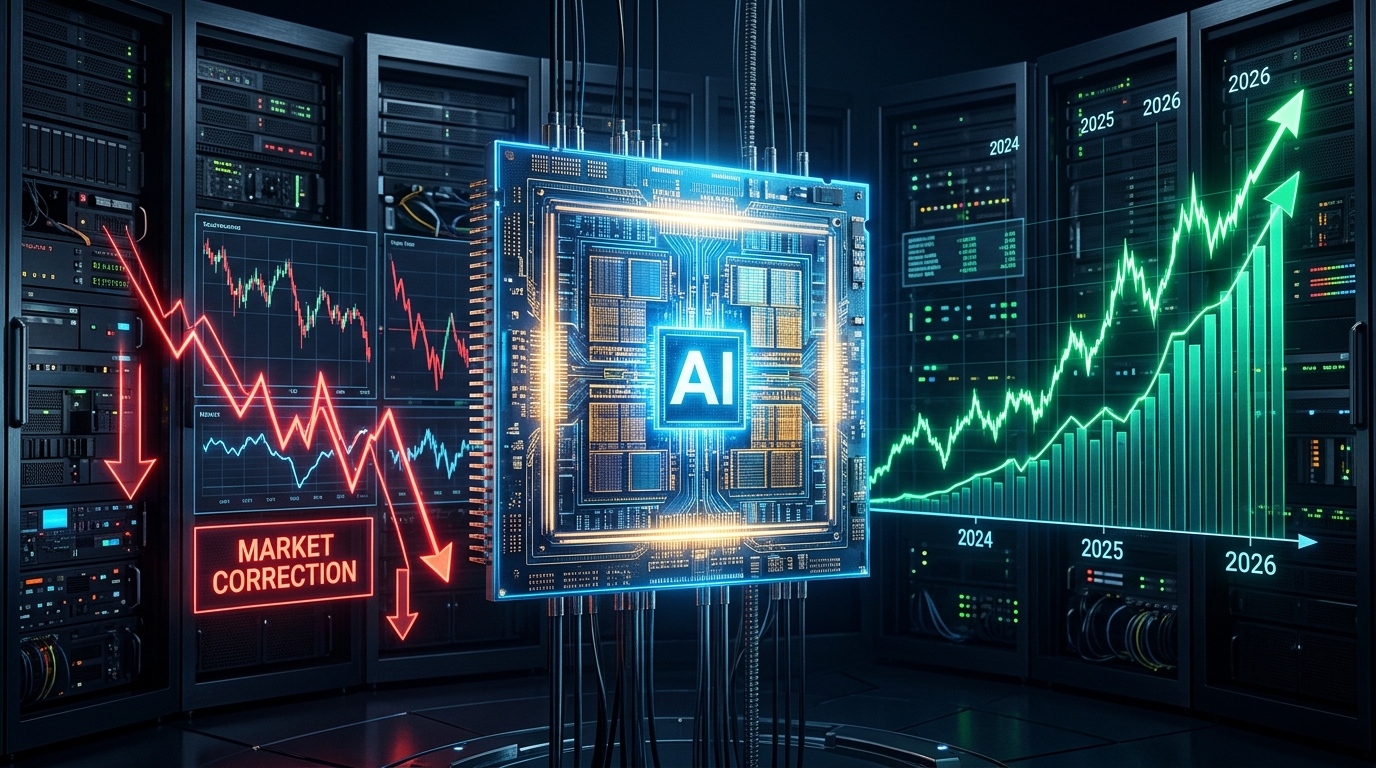
Wall Street faces a critical question in October 2026: Is artificial intelligence driving a lasting economic transformation or creating another market bubble? Investors continue to weigh enormous AI opportunities against rising costs, ambitious valuations, and uncertain returns.
The debate has become increasingly important as technology companies invest billions in AI infrastructure. Meanwhile, investors want proof that these investments will generate sustainable profits. The AI market is being viewed in two very different ways: as a lasting force that may transform the economy, or as a hype-driven boom that could lose momentum.
What Is an AI Supercycle?
An AI supercycle is an extended stretch of growth fueled by wider AI use, continued investment, and new breakthroughs. Unlike a short-lived technology trend, a supercycle could transform industries over many years.
For example, businesses can use AI to automate repetitive tasks, improve customer service, and analyze complex information. Furthermore, developers can build AI agents that complete multistep workflows with limited human intervention.
These capabilities could increase productivity across healthcare, finance, manufacturing, logistics, and software development. Therefore, supporters believe AI could create lasting economic value rather than temporary market excitement.
However, a genuine supercycle requires more than technological breakthroughs. Companies must turn AI capabilities into reliable products, recurring revenue, and measurable productivity gains.
Why Wall Street Believes AI Could Keep Growing
1. Businesses Continue Exploring AI Adoption
Companies across industries are experimenting with AI tools to reduce costs and improve efficiency. Support teams are turning to AI assistants to help customers, and software developers are using AI coding tools to work more efficiently.
Moreover, businesses increasingly explore AI-powered research, forecasting, and document processing. These applications could help organizations accomplish more without proportionally increasing their workforce.
Nevertheless, experimentation does not automatically translate into profitable adoption. Companies must demonstrate that AI delivers benefits exceeding implementation, infrastructure, and maintenance costs.
2. AI Infrastructure Creates Long-Term Opportunities
AI models require substantial computing power, advanced chips, networking equipment, and data center capacity. Consequently, infrastructure providers have become important participants in the AI investment cycle.
Growing AI demand may also benefit businesses that provide cloud services, make computer chips, or supply energy. As AI workloads expand, these businesses may benefit from continued infrastructure spending.
However, investors must distinguish genuine demand from spending driven primarily by competitive pressure. Excessive infrastructure construction could create overcapacity if future demand falls short of expectations.
3. AI Could Improve Economic Productivity
Productivity growth offers one of the strongest arguments for the AI supercycle. If AI helps employees complete complex tasks faster, businesses could increase output while controlling costs.
Additionally, AI tools could accelerate scientific research, improve supply-chain planning, and support personalized services. Over time, these improvements might influence economic growth beyond the technology sector.
Still, productivity gains take time to appear in financial statements and economic statistics. Investors must therefore avoid assuming that every promising AI demonstration will produce immediate commercial success.
Why Some Investors Fear an AI Bubble
1. Technology Valuations May Outrun Profits
Market optimism can push technology stock prices above levels supported by current earnings. Some investors are willing to pay high prices for AI-related companies because they anticipate rapid future growth.
But when businesses fall short of those ambitious expectations, their share prices may be vulnerable. Even profitable businesses can experience sharp share-price declines if their growth disappoints investors.
Furthermore, elevated valuations leave less room for mistakes. If interest rates rise or earnings forecasts weaken, investors may reconsider how much they are willing to pay.
2. AI Spending Could Become Unsustainable
Building advanced AI infrastructure requires significant capital. Companies must finance chips, data centers, electricity, cooling systems, and skilled employees before receiving the full benefits.
Consequently, heavy investment can pressure cash flow, especially when revenue growth fails to match spending. Some projects may also become outdated as newer chips and models emerge.
Another concern involves overlapping investments across the technology industry. If companies build capacity faster than customers consume it, returns could weaken across the supply chain.
3. Revenue May Not Justify the Hype
AI products attract considerable attention, but commercial success depends on customer willingness to pay. Free features, intense competition, and high operating costs can limit profitability.
Moreover, businesses may struggle to measure savings from AI adoption accurately. Without clear financial benefits, customers could reduce subscriptions or delay larger deployments.
Therefore, investors should examine recurring revenue, customer retention, operating margins, and cash flow. These indicators offer stronger evidence of business sustainability than announcements alone.
AI Supercycle vs. AI Bubble: What Separates Them?
The supercycle argument focuses on lasting economic change. The bubble argument emphasizes excessive expectations and investment that exceed realistic business opportunities.
Both outcomes could develop simultaneously. AI technology might transform industries while certain companies experience inflated valuations and disappointing returns.
For instance, cloud computing became an important business infrastructure despite periods of excessive speculation surrounding internet companies. Similarly, AI could produce durable winners while weaker businesses struggle to survive.
It’s important to separate AI’s long-term promise from whether a particular company’s stock is worth its current price. A revolutionary technology does not guarantee attractive returns at every valuation.
What Investors Should Watch in October 2026
Several indicators can help investors evaluate whether AI growth remains sustainable.
- Revenue growth: Are AI products generating meaningful sales?
- Profit margins: Can companies deliver AI services efficiently?
- Capital expenditure: Are infrastructure investments producing adequate returns?
- Customer demand: Are businesses renewing contracts and expanding usage?
- Productivity gains: Can organizations demonstrate measurable improvements?
- Valuations: Do share prices reflect reasonable earnings expectations?
Additionally, investors should monitor energy availability, semiconductor supply, and data center utilization. These factors influence the cost and scalability of AI infrastructure.
Importantly, investors should compare companies individually rather than treating every AI-related stock as the same opportunity.
Could an AI Bubble Burst Without Ending the AI Revolution?
Yes. A market correction would not necessarily invalidate artificial intelligence’s long-term potential.
Stock prices reflect expectations about future profits, not simply the usefulness of a technology. Consequently, prices can fall sharply even when adoption continues expanding.
During a correction, companies with weak finances, expensive operations, or limited customer demand could face serious difficulties. Meanwhile, businesses with strong balance sheets and sustainable revenue might continue investing.
A market downturn could also reduce speculative spending and encourage more disciplined investment. However, losses could spread across technology stocks and affect companies indirectly connected to AI.
The eventual outcome would depend on financial conditions, business performance, and how quickly investors adjust their expectations.
The Bottom Line: Supercycle, Bubble, or Both?
Wall Street’s AI debate does not require choosing between two completely separate outcomes. Artificial intelligence can represent a genuine technological supercycle while simultaneously creating speculative excess in financial markets.
Over time, the most promising companies are likely to be those that put AI to practical use, stand out from competitors, and generate lasting profits. Meanwhile, companies that rely entirely on investor enthusiasm may struggle when expectations change.
In October 2026, investors should focus on measurable results instead of headlines alone. Revenue growth, cash flow, productivity improvements, and reasonable valuations can help separate durable businesses from speculative bets.
Ultimately, AI’s future may prove transformative. However, the companies that benefit most will need to turn technological promise into lasting economic value.