

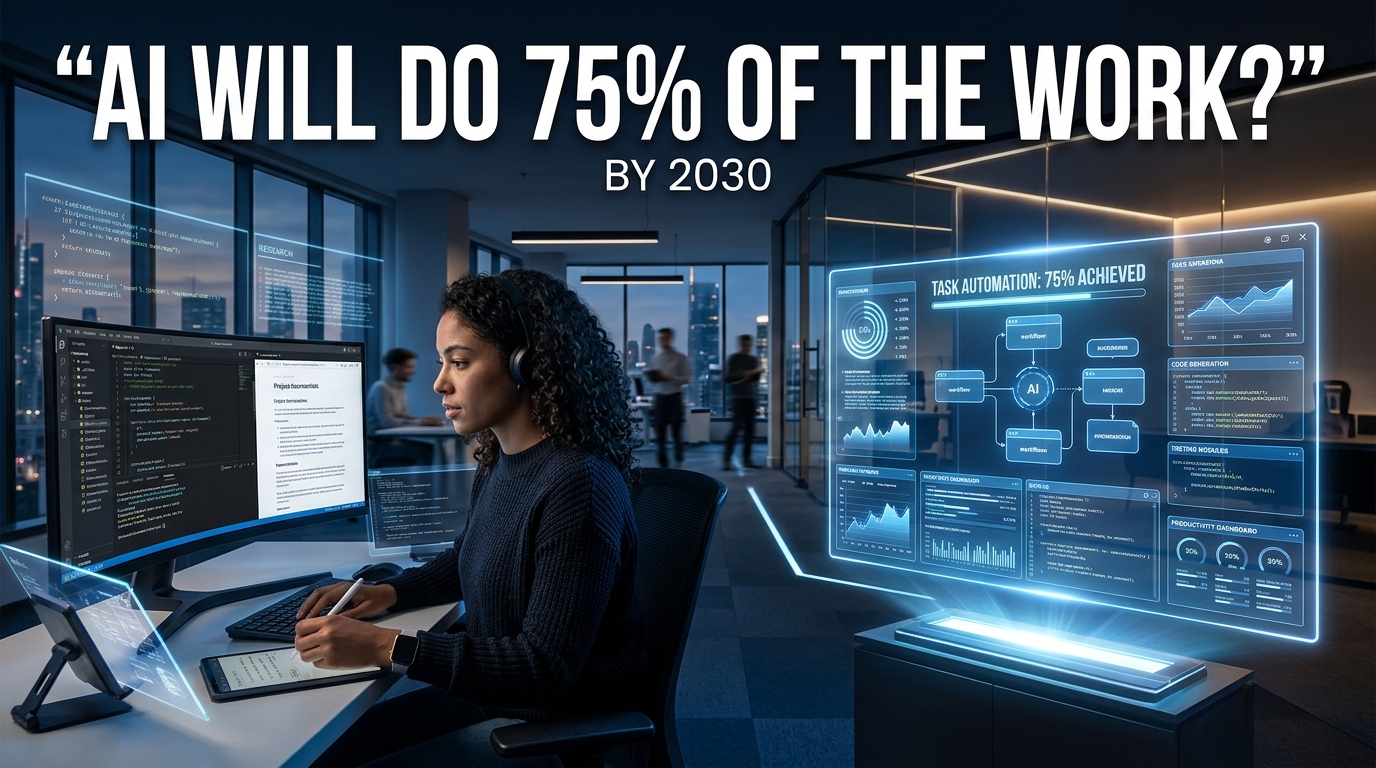
Artificial intelligence is changing how people work, and Anthropic employees expect even bigger changes ahead. Some staff members anticipate AI handling 75 percent of their work by 2030.
This expectation highlights how quickly AI capabilities are advancing. Moreover, it raises important questions about productivity, jobs, and the future of human expertise.
Why Anthropic Employees Expect AI to Handle More Work
Anthropic develops advanced AI systems designed to help people solve complex problems. Its employees work closely with technology that continues to improve. Therefore, they have a unique perspective on how AI might transform everyday tasks.
AI tools already assist with writing, coding, research, and data analysis. As these systems become more capable, employees may delegate additional responsibilities to them. Consequently, workers could spend less time completing routine tasks manually.
However, expecting AI to handle 75 percent of work does not mean every job will disappear. Instead, many employees may supervise AI systems while focusing on decisions that require human judgment.
How AI Is Transforming Everyday Workplace Tasks
AI adoption is expanding across industries. Businesses increasingly use intelligent systems to automate repetitive activities and improve efficiency. Furthermore, advanced AI assistants can support multiple stages of complex workflows.
1. AI-Powered Coding and Software Development
Software development is one area where AI can significantly change working habits. AI coding assistants can generate code, explain errors, suggest improvements, and help developers test applications.
As these tools improve, developers may delegate larger portions of software projects to AI. For example, an engineer could describe a feature and let an AI assistant produce an initial implementation.
Nevertheless, human developers would still need to review results, identify security weaknesses, and ensure reliability. This oversight becomes especially important when software handles sensitive information.
2. Automated Research and Information Analysis
Research often requires employees to examine documents, compare information, and summarize findings. AI tools can accelerate these processes by organizing large amounts of information.
Additionally, AI assistants can help identify patterns and generate initial reports. Employees could then spend more time evaluating evidence and making informed decisions.
However, AI-generated information still requires verification. Models can produce inaccurate statements or overlook important context. Therefore, human review remains essential for reliable research.
3. Faster Writing and Communication
AI tools can draft emails, summarize meetings, prepare reports, and suggest improvements to written communication. These capabilities can reduce the time employees spend on routine writing.
Moreover, AI assistants can adapt drafts for different audiences and communication styles. Workers can use the saved time to improve strategy, build relationships, and address complex problems.
Even so, successful communication requires more than grammatically correct sentences. Human judgment remains valuable when messages involve sensitive situations, negotiation, or emotional understanding.
What Does the 75 Percent Prediction Actually Mean?
The expectation that AI could handle 75 percent of work by 2030 deserves careful interpretation. It does not necessarily mean that AI will eliminate 75 percent of jobs.
Instead, the figure may refer to the share of tasks employees expect AI to perform or substantially assist with. A job typically includes many different responsibilities, and automation affects each responsibility differently.
For example, a marketing specialist might use AI for research, outlines, draft creation, and performance analysis. However, the specialist may still decide campaign priorities, approve messaging, and understand customer needs.
Similarly, a software engineer might delegate routine coding while retaining responsibility for architecture and security. Therefore, AI could transform job descriptions without removing every human role.
The distinction between automating tasks and eliminating jobs is critical. Businesses must evaluate actual workplace outcomes rather than assuming that greater AI capability automatically produces fewer employees.
How AI Could Increase Workplace Productivity
AI automation could help employees complete certain tasks faster. As a result, businesses may deliver projects more quickly and reduce repetitive workloads.
Furthermore, employees could use AI assistance to explore ideas and test potential solutions. This approach may encourage experimentation across departments.
Small businesses could also benefit from these developments. AI tools may help smaller teams handle research, customer communication, and administrative work without expanding their workforce immediately.
However, productivity gains depend on implementation. Poorly integrated tools can introduce errors, increase review requirements, and create additional work.
Businesses must therefore measure outcomes carefully. Useful indicators include completion time, accuracy, operating costs, customer satisfaction, and the amount of human correction required.
The Challenges of Depending on AI
Despite its advantages, AI introduces risks that organizations cannot ignore. Employees and managers must understand these limitations before delegating critical responsibilities.
Accuracy and Reliability
AI systems can generate convincing but incorrect information. Consequently, workers must verify important outputs before using them in business decisions.
Data Privacy and Security
Employees may accidentally expose confidential information when using inappropriate AI tools. Businesses need clear policies governing data access, storage, and approved applications.
Skills and Employee Training
Heavy dependence on automation could weaken certain skills if employees stop practicing them. Therefore, organizations should combine AI adoption with continuous learning and professional development.
Accountability and Human Oversight
AI can assist with decisions, but responsibility does not automatically transfer to the technology. Organizations need clear rules defining who reviews outputs and approves consequential actions.
Will AI Replace Jobs by 2030?
The impact of AI on employment remains uncertain. Some tasks may become automated, while other responsibilities may grow as businesses adopt new technologies.
For instance, companies might need fewer people for certain repetitive activities. At the same time, they may require specialists who can evaluate AI outputs, manage automated workflows, and protect digital systems.
Moreover, new products and services could create additional roles. How jobs are affected will hinge on several factors, including employers’ needs, advances in technology, the state of the economy, and how workers adjust.
Employees can prepare by developing skills that complement AI. Critical thinking, communication, creativity, problem-solving, and technical literacy may become increasingly valuable.
How Workers Can Prepare for an AI-Driven Future
Workers do not need to become AI researchers to benefit from these changes. Instead, they can begin by learning how AI tools support their existing responsibilities.
First, identify repetitive tasks that consume significant time. Then, experiment with appropriate AI tools and compare their results against established quality standards.
Next, develop the ability to write clear instructions and evaluate AI-generated answers. These skills help users identify mistakes and produce more useful results.
It’s also important to build your expertise and judgment instead of depending solely on automated tools. Understanding a subject makes it easier to recognize inaccurate information and make sound decisions.
Finally, remain flexible as workplace expectations change. Employees who combine practical expertise with effective AI use may adapt more successfully to evolving responsibilities.
Conclusion: The Future of Work Is Changing Quickly
Anthropic employees’ expectation that AI could handle 75 percent of their work by 2030 reflects growing confidence in automation. However, this prediction should not be treated as a guarantee about every workplace or profession.
AI is likely to reshape coding, research, writing, and many other activities. Nevertheless, accuracy, privacy, accountability, and human judgment will continue to matter.
Ultimately, the biggest opportunity may come from combining human expertise with increasingly capable AI systems. Workers and businesses that learn to use these tools responsibly could gain a meaningful advantage as the future of work evolves.