

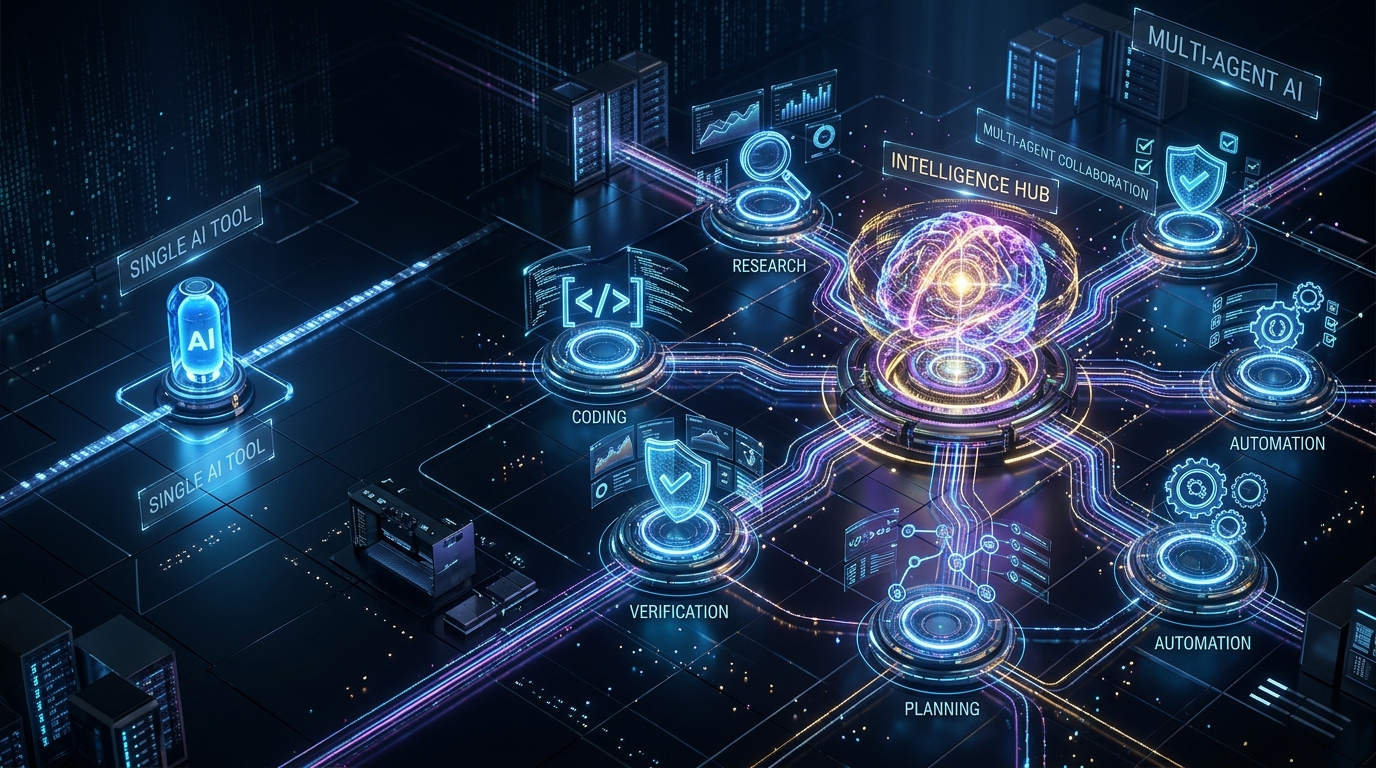
Artificial intelligence has moved beyond systems that simply answer questions or complete one task at a time. Today, businesses and developers are exploring multi agent AI, an approach where multiple AI agents work together to solve complex problems. Instead of relying on one AI system to handle an entire workflow, a multi-agent setup divides work among specialized agents and coordinates their actions.
This shift is important because many real-world tasks involve research, planning, decision-making, execution, verification, and communication. A single AI tool can perform several of these functions, but a group of specialized AI agents can approach the same problem as a coordinated team.
Understanding the difference between multi agent AI and single AI tools helps businesses decide which approach makes sense for automation, software development, research, customer service, and other workflows.
What Is Multi Agent AI?
Multi agent AI is an artificial intelligence system in which two or more autonomous or semi-autonomous AI agents collaborate to accomplish a shared objective.
Each agent can have a specific role, set of instructions, tools, or area of expertise. One agent might gather information, another could analyze it, while a third reviews the results and another prepares the final output.
For example, an AI-powered market research system could include:
- A research agent that collects relevant information.
- An analysis agent that identifies trends and patterns.
- A verification agent that checks important findings.
- A strategy agent that turns the findings into recommendations.
- A reporting agent that creates the final document.
The agents communicate through a defined workflow or coordination mechanism. Together, they can handle a larger process than an individual AI tool designed for a single purpose.
How Does a Single AI Tool Work?
A single AI tool generally uses one primary AI system to process an instruction and produce an output. Modern AI assistants can perform many different tasks, including writing, summarizing, coding, brainstorming, analyzing documents, and answering questions.
The basic process is straightforward:
User input -> AI processing -> Output
For example, a user might ask an AI assistant to analyze a business report. The same system receives the document, identifies relevant information, performs the analysis, and generates a response.
This model is extremely useful for straightforward tasks. However, complicated workflows may require the system to manage several different responsibilities at once.
Multi Agent AI vs Single AI Tools
The main difference is how work is organized.
A single AI tool usually concentrates intelligence and responsibility within one system. Multi-agent AI distributes responsibilities across multiple agents.
| Feature | Single AI Tool | Multi Agent AI |
| Number of agents | One primary agent | Multiple agents |
| Task structure | Usually centralized | Distributed |
| Specialization | General-purpose or broad | Agents can specialize |
| Collaboration | Limited or internal | Explicit agent-to-agent collaboration |
| Complex workflows | Can be challenging | Better suited to multi-step processes |
| Coordination | Usually simple | Requires orchestration |
| Verification | Often handled by the same system | Can be assigned to another agent |
| Setup | Generally easier | More complex |
The difference does not mean multi-agent systems are always necessary. For a simple request, adding multiple agents can create unnecessary complexity.
How Multi Agent AI Systems Work
A multi-agent architecture typically starts with a primary objective. The system then determines which tasks need to be completed and assigns those tasks to appropriate agents.
Consider an e-commerce company that wants to analyze declining sales.
A planning agent could first break the problem into smaller tasks. A data agent might examine sales information, while a customer-feedback agent studies reviews. Another agent could investigate competitors. An analysis agent then combines the findings and identifies possible causes.
Finally, a recommendation agent could prepare potential actions for the business.
The workflow may look like this:
Goal -> Planning -> Specialized tasks -> Agent collaboration -> Verification -> Final result
Depending on the architecture, agents may work sequentially, simultaneously, or dynamically.
Key Components of Multi Agent AI
Several components are commonly found in multi-agent systems.
Specialized AI Agents
Each agent is designed to perform a particular function. Specialization allows the system to divide complex work into manageable pieces.
A coding agent, for example, does not necessarily need to perform the same role as a research agent. Each can have different instructions, tools, and access to information.
Orchestrator or Coordinator
An orchestrator manages the overall workflow. It can determine which agent should act next, pass information between agents, and monitor whether tasks have been completed.
The orchestrator is especially important when a workflow contains dependencies.
Shared Context and Memory
Agents need a way to access relevant information produced by other agents. This can involve shared memory, databases, files, messages, or structured outputs.
Without effective context management, agents may duplicate work or make decisions using incomplete information.
Tools and External Systems
AI agents become more useful when they can interact with tools. Depending on the application, agents may use databases, APIs, search systems, software development environments, spreadsheets, or business applications.
This enables agents to move beyond generating text and actually participate in workflows.
Why Businesses Are Exploring Multi Agent AI
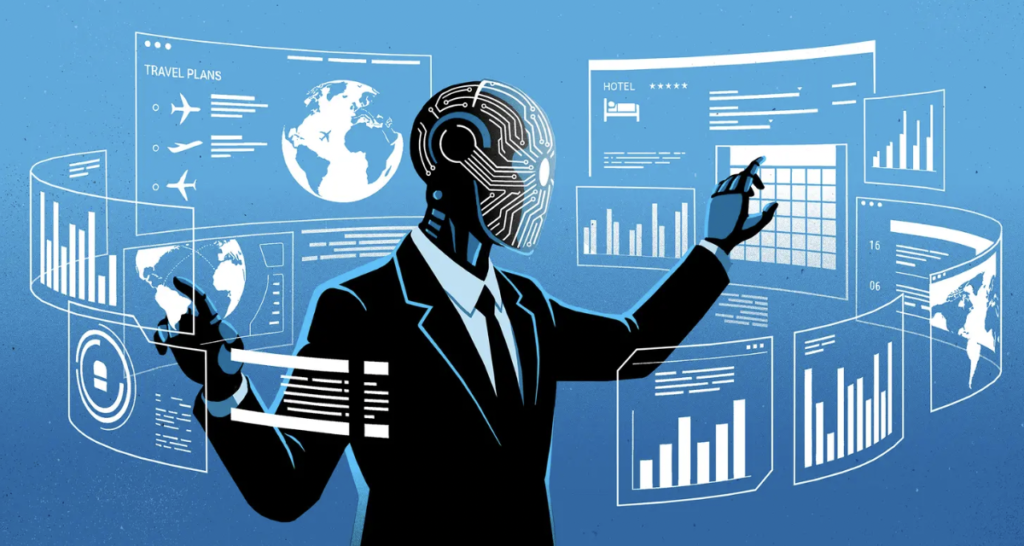
Businesses increasingly face workflows that involve multiple interconnected tasks. Automating only one step may provide limited value when employees still have to manually coordinate the remaining steps.
Multi-agent AI can potentially automate a larger portion of the workflow.
For example, a content marketing workflow could use separate agents for keyword research, competitor analysis, outlining, drafting, fact checking, SEO review, and content editing.
Instead of asking one AI system to perform every task, each agent can focus on a defined responsibility.
This approach can also make workflows easier to structure because each stage has a clear purpose.
Advantages of Multi Agent AI
Better Task Specialization
Specialized agents can be given focused instructions. A research agent can concentrate on gathering information while a reviewer focuses on identifying errors.
This separation can make complex workflows easier to design.
Parallel Processing
Some tasks do not depend on each other. Multiple agents can potentially work on these tasks simultaneously.
For example, one agent can analyze customer reviews while another examines sales data. Their results can later be combined.
Improved Workflow Automation
Multi-agent systems can connect several stages of a business process. This can reduce the need for humans to manually transfer information between separate AI tools.
Built-In Review Processes
A dedicated verification agent can review another agent’s output. This creates an additional layer of checking instead of relying entirely on the original system.
However, verification agents can also make mistakes, so important results still require appropriate human oversight.
Challenges of Multi Agent AI
Multi-agent AI introduces additional complexity.
Coordination Problems
When several agents communicate, incorrect instructions, incomplete context, or conflicting outputs can affect the final result.
A strong orchestration system is therefore essential.
Higher Costs
Every additional agent may require additional model calls, computing resources, or external tool usage. A workflow that uses five agents can consume considerably more resources than a single request.
Debugging Difficulty
Finding the source of an error can be harder in a multi-agent system. The problem may originate from the planner, an individual agent, the communication layer, or the final synthesis process.
Security and Permissions
Agents that can access business systems need carefully designed permissions. Giving an agent unnecessary access can increase security risks.
Organizations should use the principle of least privilege, allowing each agent access only to the information and tools required for its role.
When Should We Use a Single AI Tool?
A single AI tool is usually sufficient when the task is relatively straightforward.
Examples include:
- Writing a short email
- Summarizing an article
- Brainstorming ideas
- Rewriting existing content
- Explaining a technical concept
- Generating simple code
- Creating a basic outline
In these situations, adding multiple agents may increase complexity without providing enough additional value.
The simplest architecture that reliably completes the task is often the most practical starting point.
When Should We Use Multi Agent AI?
Multi-agent AI becomes more relevant when a task contains multiple specialized stages, independent subtasks, complex dependencies, or repeated decision-making.
Examples include:
- Large-scale market research
- Complex software development
- Financial data analysis
- Customer support automation
- Supply-chain workflows
- Enterprise knowledge management
- Research and report generation
- Automated business operations
The goal should not be to use as many agents as possible. Instead, organizations should identify where specialization and collaboration actually improve the workflow.
Multi Agent AI in Software Development
Software development is one area where multi-agent systems can be particularly useful.
One agent can interpret requirements, another can create code, another can generate tests, and another can review the implementation.
A simplified workflow might be:
Requirements agent -> Coding agent -> Testing agent -> Review agent -> Deployment workflow
The agents can exchange structured information at each stage.
This does not eliminate the need for developers. Human engineers remain important for architecture, security, complex debugging, product decisions, and final approval.
Multi Agent AI in Business Operations
Business operations often contain repetitive processes that involve several departments or systems.
For example, an automated sales workflow could include a lead qualification agent, research agent, personalization agent, CRM agent, and reporting agent.
The system could collect information about a lead, determine whether it meets predefined criteria, prepare relevant information, update the CRM, and create a report.
This type of automation can help organizations connect tasks that would otherwise require several separate software tools.
What Is the Future of Multi Agent AI?
The development of multi-agent AI is moving artificial intelligence toward collaborative problem solving rather than isolated task completion.
Future systems may contain agents that dynamically create subtasks, select appropriate tools, communicate with other agents, evaluate results, and adjust their strategies.
However, reliable multi-agent systems will require more than powerful AI models. They will also need strong orchestration, access controls, monitoring, evaluation, error handling, and clear human oversight.
The most practical systems are likely to combine AI autonomy with carefully defined boundaries.
Final Thoughts
Multi agent AI represents a different way of building intelligent software. Instead of asking one AI system to perform an entire complex workflow, organizations can divide responsibilities among specialized agents that collaborate toward a shared objective.
Single AI tools remain highly useful for straightforward tasks because they are easier to operate and maintain. Multi-agent systems become more relevant when workflows require multiple specialized capabilities, parallel processing, verification, and coordination.
The important distinction is therefore not simply one AI versus many AIs. It is about choosing the architecture that matches the complexity of the problem. For simple tasks, one capable AI tool may be enough. For interconnected workflows, a carefully designed multi-agent system can provide a framework for coordinating multiple forms of AI-driven work.