

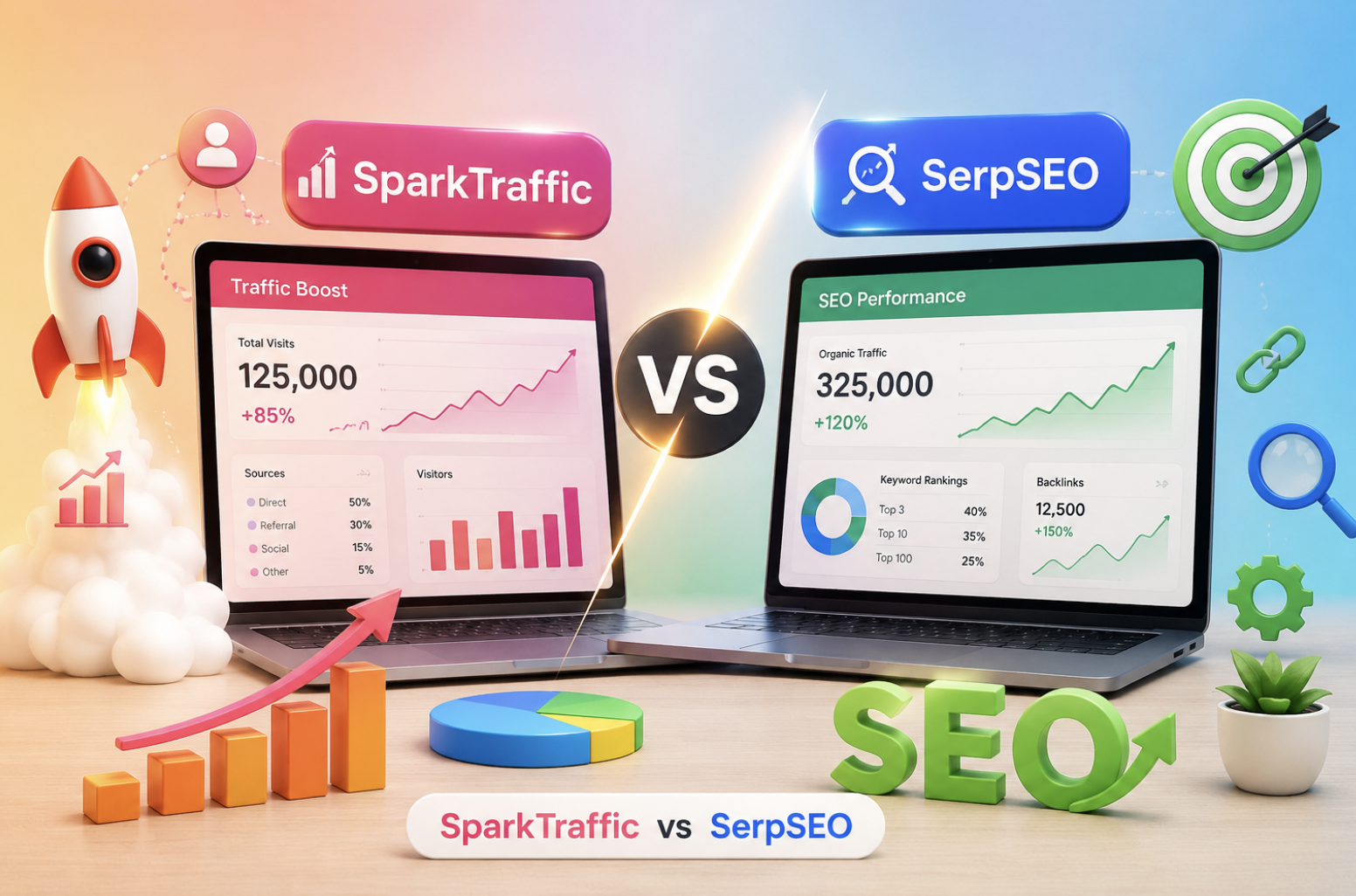
In today’s competitive digital world, website success depends heavily on visibility and traffic. Every business wants higher rankings, more clicks, and stronger online authority. However, not all tools that promise growth deliver real results. Some focus on artificial traffic, while others build genuine search engine performance. SparkTraffic and SerpSEO represent two completely different approaches. One focuses on instant numbers, while the other builds long-term SEO strength. Therefore, understanding their differences is crucial before choosing any tool.
Moreover, many website owners mistakenly believe all traffic is equal. In reality, search engines evaluate quality, engagement, and authenticity. Consequently, the wrong strategy can harm your rankings instead of improving them.
What SparkTraffic Actually Does
SparkTraffic is a traffic-generation service. It uses bots and automated scripts to simulate visits to a website, page views, scrolling behavior, clicks – designed to look like real human activity when you glance at your analytics dashboard.
It can send this simulated traffic from a range of devices and locations, and it offers some flexibility in how the traffic appears to behave, direct visits, organic-looking visits, or referral-style traffic. Developers sometimes use it to stress-test a server, checking whether a site holds up under a sudden spike in volume. Outside of that narrow technical use case, though, the traffic it generates isn’t coming from real people, which matters enormously for what it can and can’t accomplish.
None of that simulated activity contributes to actual SEO. It doesn’t generate conversions, because there’s no human on the other end to convert. Google Analytics is frequently able to flag this kind of traffic for what it is. And depending on how it’s used, it can run into conflict with Google’s search quality guidelines, which take a dim view of artificially inflated engagement signals.
What SerpSEO Actually Does
SerpSEO takes the opposite approach entirely. It’s built to improve how a website performs in organic search, not by faking activity, but by strengthening the things search engines actually evaluate: content quality, backlink profile, on-page structure, and keyword targeting.
The platform handles keyword research and competitor analysis, offers AI-assisted suggestions for improving content, helps with backlink building, tracks where a site sits in search rankings over time, and reports on overall SERP visibility. The goal throughout is straightforward, bring in real visitors by genuinely earning a better position in search results, rather than simulating one.
Where SparkTraffic is essentially a numbers illusion, SerpSEO is closer to infrastructure work. It’s slower by nature, because real ranking improvements take real time, but what it builds tends to last.
Where the Two Tools Actually Diverge
| What You’re Comparing | SparkTraffic | SerpSEO |
|---|---|---|
| Core function | Generates bot-based traffic | Optimizes for organic search performance |
| Who’s actually visiting | Simulated, non-human activity | Real people finding you through search |
| Risk profile | Can create real problems if misused for marketing | Fully compliant with search engine guidelines |
| What it’s built for | Inflating numbers, stress-testing infrastructure | Climbing rankings sustainably |
| Impact on rankings | None, no measurable SEO benefit | Direct and significant |
| Likelihood of conversions | Essentially zero | Meaningfully higher, since visitors are real |
| Cost vs. payoff | Inexpensive but offers nothing lasting | Costs more upfront, pays off over time |
| Best suited for | Technical load testing, analytics experimentation | Long-term ranking growth and content strategy |
The Honest Trade-offs of SparkTraffic
There’s a narrow context where SparkTraffic genuinely earns its place. It’s a cheap, fast way to see how a server handles a load spike, and it can be useful for developers running technical experiments or trying to understand how analytics platforms behave under artificial conditions. The traffic numbers also jump immediately, which can feel satisfying even if it’s not meaningful.
The trade-off is significant, though. None of that traffic is real, so it does nothing for actual search rankings. It can trip warnings inside Google Analytics. Using it on a live business or client website carries real risk, not just because it doesn’t help, but because it can actively raise red flags if search engines interpret the activity as manipulation. Lean on it too heavily, and it can quietly damage the credibility of a site that’s supposed to be building trust with real visitors.
The Honest Trade-offs of SerpSEO
SerpSEO’s strength is that everything it builds is real. Rankings that improve through this kind of work tend to bring organic traffic that actually converts, content that genuinely gets better, and a domain that gradually earns more authority, all of it compliant with how search engines actually want sites to grow.
The catch is patience. This approach is slower than anything bot-driven, by definition. It requires consistent effort rather than a one-time setup, generally costs more upfront than a traffic-bot service, and how quickly it pays off depends heavily on your industry and how competitive your specific space is. There’s no shortcut hiding inside it, which is exactly why it works.
So Which One Should You Actually Use?
The honest answer depends entirely on what you’re trying to accomplish.
SparkTraffic makes sense if you’re testing how your website holds up under heavy load, checking how your analytics setup behaves under unusual traffic patterns, or running technical research where you fully understand, and accept, that the traffic isn’t real and won’t move any SEO needle.
SerpSEO makes sense if you want actual growth: real visitors, improved Google rankings, stronger domain authority, and a website that can scale sustainably over time rather than just look busy on a dashboard.
For most businesses, the decision isn’t close. If the goal is genuine SEO growth, SerpSEO, or any legitimate SEO platform built around the same principles, is the safer and more effective choice by a wide margin. SparkTraffic has its place, but that place is technical testing, not marketing or ranking strategy.
Does SparkTraffic Help Google Rankings at All?
No, and it’s worth being direct about that. Google’s ranking systems are built to evaluate quality content, genuine user engagement, real backlinks, and overall domain trust. Bot-generated visits simply don’t touch any of those signals, there’s no engagement happening, because there’s no person there to engage.
Is SerpSEO Enough on Its Own?
It can cover most of the core SEO workload, keyword planning, backlink analysis, on-page optimization, and tracking shifts in search visibility. For a full-scale SEO campaign, though, it’s common to pair it with other established tools like Ahrefs, SEMrush, Google Search Console, or Screaming Frog, each of which brings additional depth in specific areas.
Conclusion
If the goal is real growth, actual rankings, actual visitors, a website that builds momentum over time, SerpSEO is the clear choice. It’s built around authenticity and long-term strategy rather than a quick visual bump in your dashboard.
SparkTraffic isn’t without any use, but its use case is narrow and technical. Treated as a marketing or SEO tool, it offers nothing real and carries genuine risk. Treated as a load-testing utility, it does exactly what it’s designed to do.
Frequently Asked Questions
1. Is SparkTraffic safe to use?
It’s reasonably safe for technical testing purposes, but not for SEO or marketing campaigns. Google’s systems are generally capable of identifying artificial traffic patterns.
2. Can SparkTraffic increase my Google ranking?
No. It has no positive effect on SEO and doesn’t influence search rankings in any measurable way, since the traffic isn’t coming from real users.
3. What is SerpSEO actually used for?
Keyword research, on-page optimization, rank tracking, and organic traffic growth, the core building blocks of a real SEO strategy.
4. Which tool is better for long-term growth?
SerpSEO, without much debate. It’s built around real users and sustainable ranking improvements rather than artificial numbers.
5. Can SparkTraffic and SerpSEO be used together?
Technically yes, but only if SparkTraffic stays limited to testing purposes. SerpSEO should remain your primary tool for any actual growth strategy.
6. Does Google penalize bot traffic directly?
Not always in the form of an explicit penalty, but it can filter or ignore that traffic entirely, which often results in distorted, unreliable analytics data.
7. Which tool makes more sense for beginners?
SerpSEO. It guides newer users toward building genuine search visibility instead of producing numbers that look good but don’t actually mean anything.