

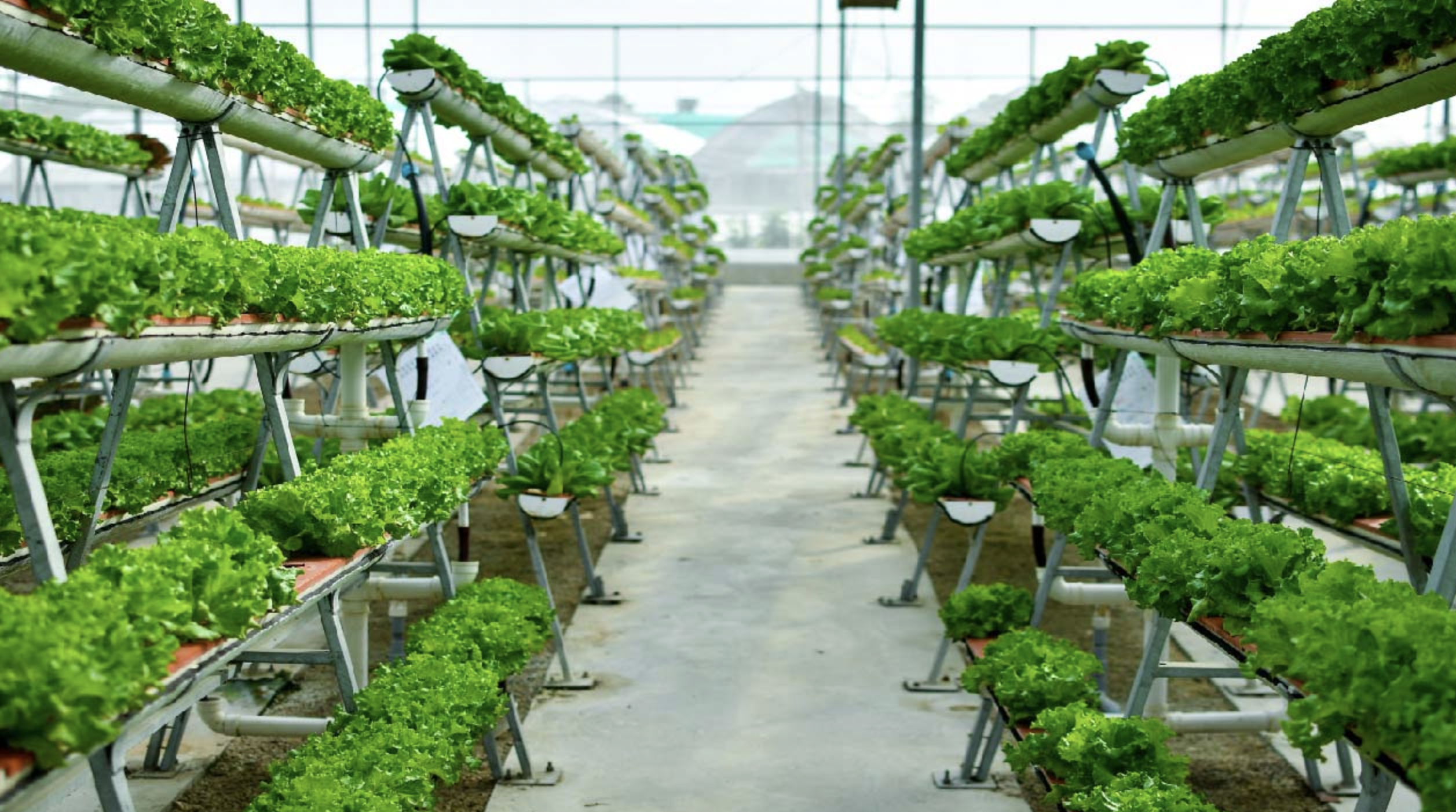
Warehouses stacked with leafy greens under rows of pink-tinted LED lights have become one of the more visible experiments in reshaping where food comes from. Vertical farming, the practice of growing crops in stacked layers inside climate-controlled buildings, promises fresher produce grown closer to cities, less water use than traditional field farming, and a way to keep growing food even as usable farmland shrinks or shifts under climate pressure.
The industry has moved well past the pilot stage, but the path from promising demonstration to dependable, profitable food source has proven far bumpier than early coverage suggested.
Rethinking Where Food Grows
Traditional agriculture depends on open land, seasonal weather, and long supply chains that move produce from rural growing regions to distant urban grocery stores. Vertical farming flips that model by placing growing operations inside warehouses or repurposed industrial buildings, often located near or inside the cities where the food will be sold. Layers of crops are stacked vertically, sometimes a dozen or more levels high, each fitted with its own lighting, irrigation, and climate control systems.
This approach appeals to planners and companies dealing with several pressures at once. Arable land near major population centers has become scarce and expensive, while transportation costs and spoilage during long-distance shipping erode both freshness and profit margins for perishable produce like leafy greens and herbs. By growing food close to where it will be consumed, vertical farms can shrink the distance between harvest and shelf from days to hours, which matters a great deal for delicate crops that lose flavor and nutritional value quickly after picking.
The concept is not entirely new. Greenhouse agriculture and hydroponics have existed for decades, but vertical farming pushes the idea further by adding full climate independence from outdoor conditions and stacking growing space to multiply yield per square foot of building footprint. This makes it possible, in principle, to grow food in places with poor soil, extreme climates, or limited available land, including dense urban centers and regions facing water scarcity. Several structural pressures explain why vertical farming attracted so much attention from investors, city planners, and grocery chains over the past decade:
- Shrinking arable land: Urban sprawl and soil degradation have reduced usable farmland near many population centers, pushing food production farther from consumers.
- Long, fragile supply chains: Produce traveling long distances is vulnerable to spoilage, price shocks, and disruption from weather events along the route.
- Water scarcity in growing regions: Traditional irrigation draws heavily on regional water supplies that are becoming less reliable in several major agricultural areas.
- Consumer demand for freshness: Shoppers increasingly favor locally grown produce, associating shorter supply chains with better taste and higher nutritional quality.
- Climate volatility: Unpredictable weather patterns make outdoor harvest yields less consistent, encouraging some buyers to look toward climate-controlled alternatives.
None of these pressures alone would have been enough to justify the capital investment vertical farming requires, but together they created an opening for indoor agriculture to position itself as a complementary, rather than competing, part of the food supply chain.
Core Technologies Behind Indoor Agriculture
Several technological developments converged to make vertical farming commercially viable rather than purely experimental. LED lighting efficiency improved dramatically over the past decade, reducing the electricity cost of providing plants with the specific light wavelengths they need for photosynthesis. Sensor networks and automation software now allow operators to monitor and adjust temperature, humidity, nutrient concentration, and light exposure with a level of precision that outdoor farming can never match, since weather cannot be controlled the way an indoor environment can. Key technologies underpinning modern vertical farms include:
- LED grow lighting: Tunable light spectrums matched to specific crop needs, reducing energy waste compared with older lighting technologies.
- Hydroponic and aeroponic systems: Soil-free growing methods that deliver nutrients directly to plant roots through water or a fine mist, cutting water use compared with soil-based irrigation.
- Climate control automation: Sensor-driven systems that maintain precise temperature and humidity levels tailored to each crop cycle.
- Vertical rack and conveyor design: Stacked growing trays, sometimes on moving conveyor systems, that maximize usable growing area within a fixed building footprint.
- Data-driven crop monitoring: Cameras and sensors that track plant health and growth rates, feeding data into software that flags problems before they spread.
These systems together allow year-round production unaffected by outdoor seasons, pests, or extreme weather events, a real advantage as climate volatility makes traditional field farming less predictable in many regions. Automation has also reduced the labor intensity of vertical farming compared with early pilot facilities that relied heavily on manual planting, monitoring, and harvesting.
Robotic seeding arms, automated harvesting conveyors, and machine-vision systems that identify plant stress or disease before it spreads visually have all moved from research prototypes into commercial deployment at larger facilities. This shift matters because labor costs, alongside electricity, represent one of the largest ongoing operating expenses for any indoor farming operation, and any reduction in manual labor requirements directly improves the odds of long-term profitability.
Software has become just as central to modern vertical farms as the physical growing infrastructure itself. Farm management platforms now track growth data across every crop cycle, building a historical record that operators use to fine-tune lighting schedules, nutrient formulas, and harvest timing for each variety grown in the facility. Over multiple cycles, this data-driven approach allows a facility to steadily improve yield per square foot, a metric that matters enormously given how much capital is tied up in the building and equipment itself.
Economics of Scaling Up
Despite real technological progress, the economics of vertical farming remain the industry’s toughest challenge. Building and operating a vertical farm requires substantial upfront capital for climate control infrastructure, lighting systems, and specialized racking, along with ongoing electricity costs that far exceed what traditional farms spend on comparable growing space. Several high-profile vertical farming startups have shut down or scaled back operations after struggling to reach profitability, even with large amounts of venture funding behind them.
The core economic tension is straightforward: electricity to power lighting and climate control is expensive, and crops grown this way need to command a high enough retail price to cover those costs while still competing with conventionally grown produce on supermarket shelves. This has pushed most commercially successful vertical farms toward high-value, fast-growing crops like leafy greens, herbs, and microgreens rather than staple crops like wheat, rice, or corn, which have far thinner profit margins and would require enormous scale to justify the infrastructure investment.
Location decisions also affect the underlying economics. Farms built near urban centers pay a premium for real estate and industrial space but save on transportation and benefit from faster access to local retail and restaurant customers. Farms located farther from cities reduce real estate costs but reintroduce some of the transportation expense and delivery delay that vertical farming was originally meant to eliminate, narrowing the advantage over conventional greenhouse operations.
Labor structure also differs from what many expect when picturing a farm. Instead of seasonal outdoor field workers, vertical farms tend to employ a smaller, steadier team of technicians who monitor automated systems, manage crop cycles, and handle equipment maintenance year-round. This creates more predictable staffing costs than traditional agriculture, which swings sharply between planting and harvest seasons, but it also requires a workforce with a different skill set, blending horticultural knowledge with familiarity around sensors, software dashboards, and mechanical systems.
Crops That Fit the Model
Not every crop makes economic or practical sense for vertical farming, which has led the industry to concentrate around a relatively narrow set of products where the model’s strengths line up well with consumer demand and cost structures. Crops best suited to current vertical farming technology share several traits:
- Fast growth cycles: Leafy greens and herbs mature in weeks rather than months, allowing more harvest cycles per year to spread fixed costs across more product.
- Low physical weight and volume: Lightweight crops like lettuce and basil are cheaper to grow under artificial light than dense, heavy crops requiring more energy per unit of yield.
- High retail price relative to weight: Specialty greens, microgreens, and herbs often sell at premium prices that better absorb higher production costs.
- Sensitivity to shipping and spoilage: Delicate produce that degrades quickly during transport benefits most from the shortened supply chain vertical farms offer.
- Consistent year-round demand: Crops with steady retail and restaurant demand throughout the year make better use of continuous production capacity.
Staple grains and root vegetables remain far outside the economic reach of current vertical farming technology, since their low retail price per unit of weight cannot cover the energy costs involved in growing them indoors under artificial light at commercial scale. Some researchers are experimenting with hybrid approaches, such as growing seed potatoes or breeding stock indoors under controlled conditions while leaving bulk production of the final crop to outdoor fields, capturing some benefits of indoor growing without needing to scale the entire production run indoors.
Environmental Trade-offs
Vertical farming is often marketed as an environmentally superior alternative to conventional agriculture, and in some respects the comparison holds. Water use per unit of crop yield tends to be dramatically lower than field farming, since closed-loop hydroponic systems recirculate water rather than losing it to evaporation, runoff, or soil absorption the way open-field irrigation does. Pesticide use is also largely eliminated in fully enclosed indoor environments, since pest pressure common in open fields simply does not exist inside a sealed growing facility.
However, the energy trade-off complicates any simple claim of environmental superiority. Powering LED lighting and climate control systems around the clock consumes a large amount of electricity, and the overall environmental benefit depends heavily on where that electricity comes from. A vertical farm powered by a grid still dependent on fossil fuels may carry a larger carbon footprint than a conventional farm relying primarily on sunlight, even after accounting for water savings and reduced pesticide use.
This has pushed several vertical farming operators toward pairing facilities with renewable energy sources, such as on-site solar installations or long-term renewable power contracts, to strengthen the environmental case for their operations. As renewable electricity becomes cheaper and more widely available, the environmental calculus for vertical farming is likely to shift further in its favor, though this depends on broader energy grid trends rather than anything the vertical farming industry controls directly.
Land use offers another angle on the environmental comparison. Because vertical farms stack growing space upward rather than spreading it across open fields, they can produce far more food per acre of building footprint than conventional farming produces per acre of land. This matters in regions where converting additional land to agriculture would come at the cost of forests, wetlands, or other ecosystems that provide their own environmental value beyond food production. Supporters argue that concentrating high-yield production in dense indoor facilities could, over time, ease pressure to convert further wild land into farmland, even though this remains a longer-term possibility rather than a proven outcome at current industry scale.
Regulatory and Investment Landscape
Vertical farming occupies a somewhat unusual regulatory position, since it does not fit neatly into either traditional agricultural policy frameworks or standard industrial building codes. Food safety regulations generally apply in similar ways to indoor and outdoor growing operations, but zoning rules governing where indoor farms can operate, along with agricultural subsidy programs designed around traditional field farming, have been slower to adapt to this newer growing model.
Investment in the sector has cooled from its peak enthusiasm several years ago, when venture capital poured into vertical farming startups betting on rapid scale-up. A wave of high-profile bankruptcies and downsizing across the industry tempered expectations and pushed remaining companies toward more conservative growth strategies, focusing on profitability within a narrower crop selection rather than rapid geographic expansion.
Some governments have started to view vertical farming as a component of food security strategy, especially in regions with limited arable land or heavy reliance on imported produce. Countries with dense populations and constrained agricultural land have shown interest in supporting indoor agriculture through grants, research partnerships, or favorable zoning, viewing it as a way to reduce dependence on imported fresh produce even if the economics remain challenging on a purely commercial basis. A handful of policy and financing questions tend to come up repeatedly as regulators and investors evaluate the sector:
- Zoning classification: Whether indoor farms fall under agricultural, industrial, or a hybrid zoning category affects taxation, permitting, and eligibility for farm subsidies.
- Energy pricing and incentives: Access to discounted industrial electricity rates or renewable energy credits can materially change a facility’s operating economics.
- Food safety oversight: Regulators are adapting inspection standards originally built for field agriculture to fit fully enclosed, climate-controlled growing environments.
- Access to agricultural subsidies: Many farm support programs were designed around traditional field farming and do not yet extend cleanly to indoor operations.
- Research funding partnerships: Universities and public agencies increasingly co-fund pilot facilities to study crop yield optimization and energy efficiency improvements.
Investors evaluating the sector today tend to favor companies with a narrower crop focus and a clear path to profitability over the earlier wave of ventures that pursued rapid multi-city expansion before proving a durable business model in a single location.
Final Thoughts
Vertical farming represents a compelling response to real pressures facing global food systems, including shrinking arable land, water scarcity, and the environmental cost of long supply chains. The technology has matured a great deal, but economic constraints, especially the cost of electricity, continue to limit which crops make commercial sense to grow this way.
Rather than replacing conventional agriculture outright, vertical farming looks poised to occupy a specific niche focused on fresh, high-value produce grown close to urban consumers. Its long-term success will likely depend as much on falling renewable energy costs and supportive zoning policy as on advances in the growing technology itself.
Frequently Asked Questions
Is vertical farming more expensive than traditional farming?
Generally yes, mainly due to electricity costs for lighting and climate control, which is why vertical farms currently focus on high-value crops like leafy greens rather than staple grains that could not absorb those costs.
What crops are best suited to vertical farming?
Fast-growing, lightweight crops with high retail value relative to their weight, such as lettuce, herbs, and microgreens, currently represent the most commercially viable options for indoor vertical growing operations.
Does vertical farming use less water than traditional agriculture?
Yes, closed-loop hydroponic and aeroponic systems recirculate water rather than losing it to evaporation or runoff, typically resulting in far lower water use per unit of crop yield compared with field farming.
Why have some vertical farming companies failed?
High operating costs, especially electricity for lighting and climate control, combined with a limited range of profitable crops, have made it hard for some vertical farming startups to reach sustainable profitability despite strong initial investment.
Is vertical farming better for the environment than traditional farming?
It depends on the electricity source powering the facility. Vertical farms save water and eliminate pesticide use, but if powered by a fossil-fuel-heavy electrical grid, the energy footprint can offset some of those environmental gains.
Can vertical farming grow staple crops like wheat or rice?
Not currently at any real commercial scale. The low retail value of staple grains relative to their growing costs makes indoor cultivation of these crops economically impractical with today’s technology and energy costs.