

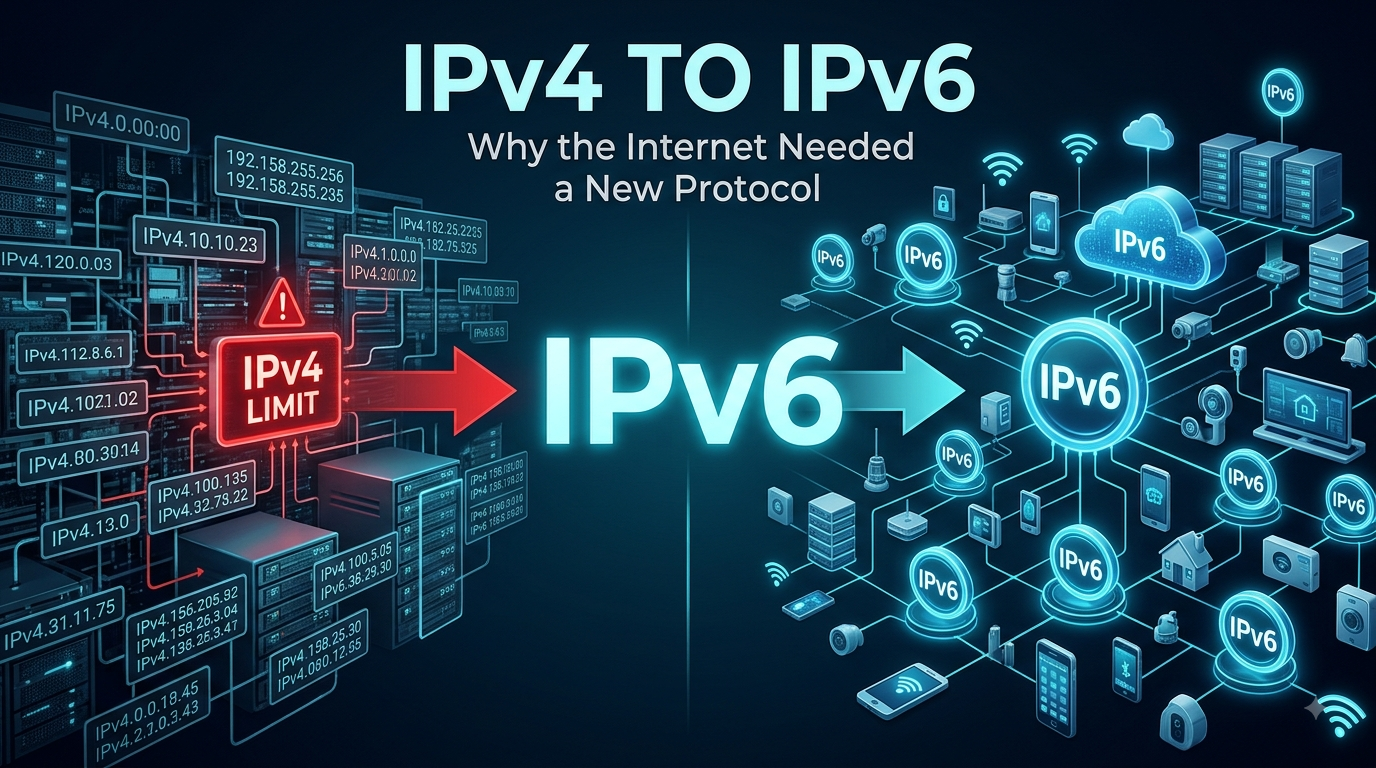
The internet has grown from a small network connecting computers into a global system containing billions of devices. Smartphones, laptops, servers, smart TVs, cameras, vehicles, and IoT devices all need network addresses to communicate.
For decades, IPv4 provided those addresses. But IPv4 has a major limitation: it can only provide a limited number of unique addresses.
That is why IPv6 was created.
IPv6 provides an enormous address space and several networking improvements designed to support the continued growth of the internet. However, the internet did not switch from IPv4 to IPv6 overnight. Both protocols continue to operate alongside each other.
Let’s look at why IPv6 became necessary and how the transition works.
What Is IPv6?
IPv6 stands for Internet Protocol version 6. It is the newer version of the Internet Protocol used to identify devices and route data across networks.
Every device communicating over an IP network needs an address. IPv6 uses 128-bit addresses, giving it an enormously larger address space than IPv4.
An IPv6 address looks something like this:
2001:db8:85a3::8a2e:370:7334
Instead of using the familiar decimal format of IPv4, IPv6 uses hexadecimal numbers separated by colons.
The primary reason for this design is simple: there are far more IPv6 addresses available.
What Is IPv4?
IPv4 stands for Internet Protocol version 4 and has been a core part of internet communication for decades.
IPv4 uses 32-bit addresses, which provides approximately 4.3 billion possible addresses.
An IPv4 address looks like:
192.168.1.1
When IPv4 was designed, billions of addresses seemed like an enormous amount.
But the internet expanded much faster than its original designers could have expected.
Today, one person might have multiple connected devices, while businesses operate thousands or millions of networked systems.
This created a serious shortage of IPv4 addresses.
Why Did IPv4 Addresses Run Out?
The internet experienced enormous growth through personal computers, broadband, smartphones, cloud computing, and connected devices.
Every public-facing device or service may require an IP address.
The problem became particularly obvious as smartphones and other mobile devices became widespread.
The world eventually needed more addresses than IPv4 could efficiently provide.
Fortunately, engineers developed technologies that helped extend the life of IPv4.
One of the most important is Network Address Translation (NAT).
How NAT Helped IPv4 Survive
Network Address Translation (NAT) enables several devices within a private network to use a single public IPv4 address for internet access.
For example, your home may have:
- Several smartphones
- Laptops
- Smart TVs
- Gaming consoles
- Security cameras
These devices can use private IPv4 addresses inside your home while your router uses a public address to communicate with the internet.
NAT significantly reduced the number of public IPv4 addresses required.
However, it is essentially a workaround for address scarcity rather than a permanent solution.
IPv6 was designed to solve the problem at its foundation.
How Many IPv6 Addresses Are There?
IPv6 uses 128-bit addresses compared with IPv4’s 32 bits.
That means IPv6 provides approximately 340 undecillion addresses.
The exact number is:
340,282,366,920,938,463,463,374,607,431,768,211,456
You do not need to memorize that number.
The important point is that IPv6 provides an almost unimaginably larger address space than IPv4.
This allows the internet to continue growing without depending so heavily on address-sharing techniques.
IPv6 vs. IPv4
The biggest differences are easy to understand:
| Feature | IPv4 | IPv6 |
| Address size | 32-bit | 128-bit |
| Example | 192.168.1.1 | 2001:db8::1 |
| Address availability | Limited | Extremely large |
| Address format | Decimal | Hexadecimal |
| NAT | Widely used | Less necessary |
| Configuration | DHCP/manual | SLAAC/DHCPv6/manual |
| Broadcast | Supported | Not used |
IPv6 was designed not only to provide more addresses but also to support modern network requirements.
What Makes IPv6 Different?
One important IPv6 feature is Stateless Address Autoconfiguration (SLAAC).
SLAAC can allow devices to automatically configure their IPv6 addresses using information from the network.
This can simplify network administration, especially when large numbers of devices need to connect.
IPv6 also uses a simplified header structure compared with IPv4, helping routers process packets efficiently.
Another important feature is its support for multicast communication.
IPv6 also includes standardized support for security technologies such as IPsec, although using IPv6 does not automatically make a network secure.
Did the Entire Internet Switch to IPv6?
Not exactly.
This is an important misconception.
There was no single day when the world turned off IPv4 and activated IPv6.
Instead, the transition has happened gradually.
IPv4 remains widely used, while IPv6 adoption continues to grow.
Many networks use dual stack, meaning they support both IPv4 and IPv6 simultaneously.
A device might therefore have both an IPv4 and IPv6 address.
When connecting to a website, the network can use whichever protocol is available and appropriate.
Why Can’t We Just Replace IPv4 Completely?
Replacing IPv4 everywhere would be extremely difficult.
There are billions of devices, applications, routers, servers, and networks that were designed around IPv4.
Many older systems cannot simply be upgraded overnight.
Businesses also need to maintain compatibility with customers and partners that still use IPv4.
For this reason, IPv6 adoption has been designed as a gradual transition rather than an immediate replacement.
Technologies such as dual stack and NAT64 help IPv4 and IPv6 environments coexist.
What Is NAT64?
NAT64 is a transition technology that can help IPv6-only devices communicate with IPv4 systems.
This is useful because some networks and services may support IPv6 while others remain IPv4-only.
Instead of requiring every system to support both protocols immediately, technologies like NAT64 help bridge the gap.
These transition mechanisms are important because the internet is made up of countless independent networks.
Does IPv6 Make Internet Faster?
IPv6 does not automatically make your internet connection faster.
Your internet performance depends on factors such as:
- ISP infrastructure
- Network congestion
- Routing
- Server performance
- Wi-Fi quality
- Hardware
- Distance between networks
In some situations, IPv6 can provide a more efficient network path.
But switching from IPv4 to IPv6 should not be viewed as a guaranteed speed upgrade.
Its primary advantage is scalability.
Is IPv6 More Secure Than IPv4?
IPv6 includes security capabilities and was designed with modern networking requirements in mind.
However, IPv6 is not automatically secure.
A poorly configured IPv6 network can still have vulnerabilities.
Organizations should protect both IPv4 and IPv6 traffic using:
- Firewalls
- Access controls
- Monitoring
- Secure configurations
- Authentication
- Regular security updates
One common mistake is securing IPv4 while forgetting that IPv6 traffic is also enabled.
Why IPv6 Matters for IoT
The Internet of Things (IoT) is another major reason IPv6 matters.
Modern networks can contain huge numbers of connected devices, including:
- Smart appliances
- Sensors
- Cameras
- Vehicles
- Industrial equipment
- Smart home devices
- Wearable technology
IPv6’s enormous address space makes it much easier to accommodate continued growth in connected devices.
As smart cities, connected vehicles, industrial IoT, and home automation expand, scalable addressing becomes increasingly important.
Will IPv4 Disappear?
IPv4 is unlikely to disappear quickly.
It is deeply embedded in existing infrastructure, applications, and networks.
Instead, the internet is moving toward a long period of coexistence.
IPv6 adoption will continue increasing, while IPv4 remains necessary for many older systems.
The future internet will therefore likely contain both protocols for many years.
Conclusion
IPv6 was created because the internet eventually outgrew IPv4’s limited address space.
IPv4 provides around 4.3 billion theoretical addresses, while IPv6 provides an enormous 128-bit address space capable of supporting the continued expansion of the connected world.
Technologies such as NAT helped extend IPv4’s usefulness, but they could not eliminate the underlying limitation.
IPv6 provides a long-term solution while also offering modern networking capabilities such as easier address configuration and improved scalability.
The internet did not completely switch from IPv4 to IPv6 in one step. Instead, both protocols continue to operate together through technologies such as dual stack and NAT64.
For everyday users, much of this transition happens behind the scenes.
But for businesses, developers, network administrators, and technology professionals, understanding IPv6 is becoming increasingly important.
IPv4 built much of today’s internet. IPv6 is helping prepare it for tomorrow’s connected world.
FAQ’s
1. What is IPv6?
IPv6 is the newer version of the Internet Protocol. It uses 128-bit addresses to provide a vastly larger number of IP addresses than IPv4.
2. Why was IPv6 needed?
IPv6 was primarily created because IPv4 has a limited address space that could not support the long-term growth of internet-connected devices.
3. Is IPv6 faster than IPv4?
Not necessarily. IPv6 can provide efficient routing in some situations, but it does not automatically make an internet connection faster.
4. Are IPv4 and IPv6 compatible?
They are separate protocols, but technologies such as dual stack and NAT64 allow IPv4 and IPv6 networks to coexist and communicate.
5. Is IPv6 more secure?
IPv6 includes security-related capabilities, but proper configuration is still essential. IPv6 is not automatically secure simply because it is newer.