

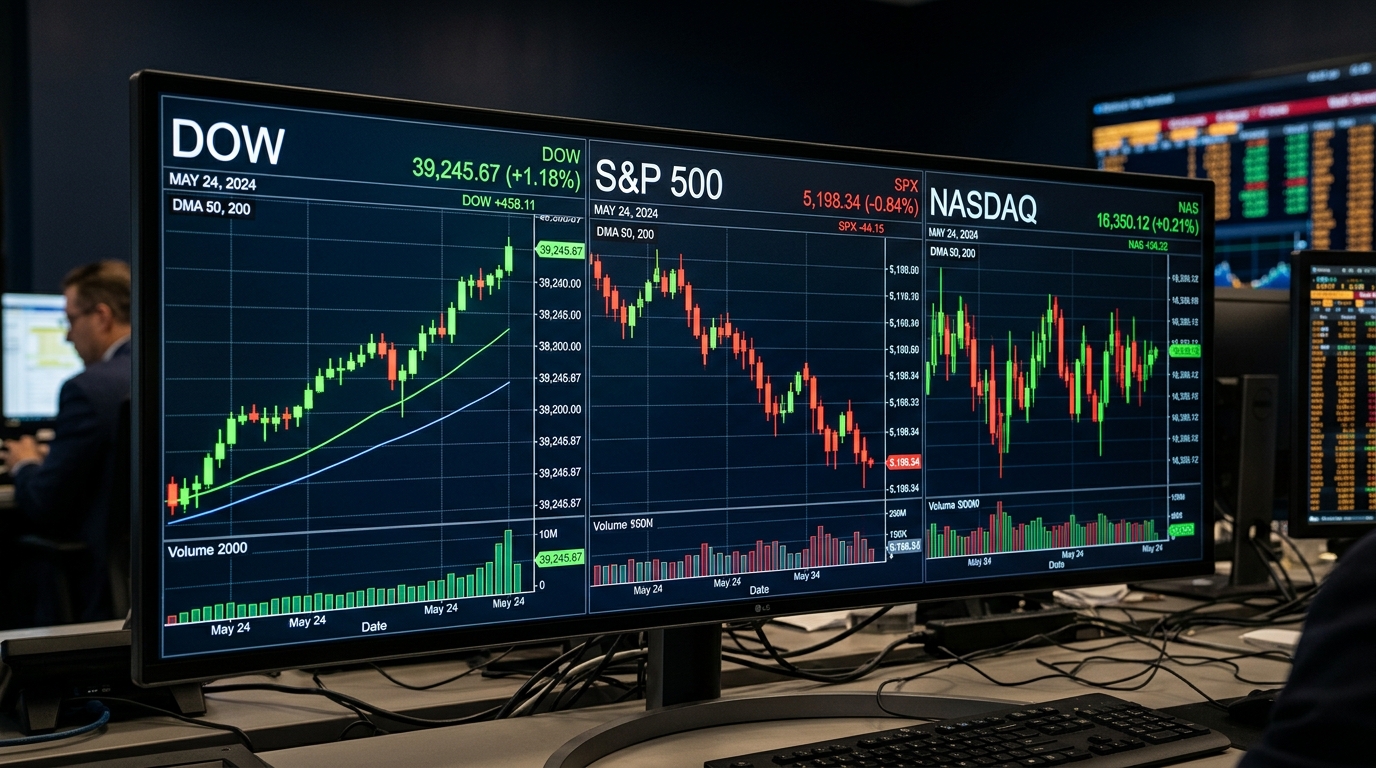
Financial news often reports movements in the Dow, S&P 500, and Nasdaq together. However, these major stock market indexes rarely move identically. Sometimes the Dow rises while the Nasdaq falls. On other days, technology stocks surge while broader markets struggle.
These differences can confuse investors, especially beginners. Understanding how each index works makes daily market movements easier to interpret. More importantly, investors can identify which sectors influence market performance.
What Are the Dow, S&P 500, and Nasdaq?
The Dow, S&P 500, and Nasdaq measure different parts of the American stock market. Each index follows a different methodology and includes different companies.
Therefore, their daily performances can tell different stories about market conditions.
Dow Jones Industrial Average
Often shortened to “the Dow,” the Dow Jones Industrial Average follows 30 prominent U.S. businesses. These businesses represent several important industries, including healthcare, finance, technology, and consumer goods.
Unlike other major indexes, the Dow uses price weighting. Companies with higher share prices have greater influence over its movements.
Consequently, one expensive stock can affect the Dow significantly. Its market capitalization does not determine its index influence.
S&P 500 Index
The S&P 500 tracks approximately 500 leading publicly traded American companies. It covers a much broader portion of the stock market than the Dow.
Furthermore, the index uses market-capitalization weighting. Companies with larger market values receive greater influence.
As a result, major businesses such as Microsoft, Apple, and Nvidia can significantly affect its daily performance.
The S&P 500 also represents multiple industries. Therefore, investors frequently use it to evaluate overall American stock market performance.
Nasdaq Composite Index
The Nasdaq Composite reflects the performance of thousands of companies traded on the Nasdaq Stock Market. Its holdings include technology, healthcare, financial, and consumer businesses.
However, technology companies represent a particularly influential portion of this index.
Like the S&P 500, the Nasdaq Composite uses market-capitalization weighting. Consequently, large technology companies can drive substantial daily movements.
Investors often monitor the Nasdaq to understand technology stock performance and growth-stock sentiment.
Why Do These Three Indexes Move Differently?
Although these indexes follow the same stock market, their compositions differ considerably. Several factors explain their different daily performances.
1. Different Company Weightings
Each index assigns influence to companies differently.
The Dow emphasizes individual share prices. Meanwhile, the S&P 500 and Nasdaq emphasize company market capitalization.
Therefore, a significant movement in one expensive Dow component can influence the Dow disproportionately.
Similarly, a major technology company’s performance can affect the Nasdaq and S&P 500 more heavily.
2. Technology Stocks Influence the Nasdaq
Technology companies have substantial influence over Nasdaq performance.
When investors purchase technology stocks, the Nasdaq often benefits. However, disappointing earnings or weaker technology forecasts can pressure the index.
For example, declining semiconductor stocks might push the Nasdaq lower. Meanwhile, rising industrial and healthcare shares could support the Dow.
Consequently, both indexes can move in opposite directions.
3. Interest Rates Affect Growth Stocks
Federal Reserve interest rate decisions influence different market sectors.
Higher interest rates can create pressure on growth stocks. These companies often depend on future earnings expectations.
Additionally, higher borrowing costs can reduce business investment and consumer spending.
Technology stocks may therefore experience greater volatility during changing interest rate expectations.
Meanwhile, financial companies sometimes benefit from certain higher-rate environments. This difference can create different performances across major indexes.
4. Economic Data Impacts Industries Differently
Economic reports can influence individual sectors in different ways.
For instance, strong manufacturing data may support industrial companies. However, higher inflation figures can pressure technology stocks.
Similarly, disappointing employment numbers might increase concerns about consumer spending.
As a result, the Dow, S&P 500, and Nasdaq can respond differently to the same economic announcement.
5. Earnings Reports Create Different Market Reactions
Corporate earnings frequently explain major differences between index performances.
A strong earnings report from a large technology company can lift the Nasdaq. However, disappointing results from major industrial companies might weaken the Dow.
Likewise, unexpected guidance changes can influence investor expectations.
Therefore, earnings season often creates noticeable performance gaps between major indexes.
What Different Index Movements Tell Investors
Watching all three indexes provides a broader understanding of market conditions.
For example, consider these common market situations:
- Dow rises, Nasdaq falls: Industrial or defensive stocks may outperform technology shares.
- Nasdaq rises, Dow falls: Investors may favor technology and growth companies.
- All three indexes rise: Buying interest may extend across several market sectors.
- All three indexes fall: Widespread selling pressure may affect investor confidence.
- S&P 500 rises slowly: Gains may remain concentrated among larger companies.
However, investors should examine sector performance before drawing conclusions.
Which Index Should Investors Watch?
The best index depends on an investor’s objectives.
The Dow offers insight into 30 established American companies. Therefore, it provides a useful perspective on selected large businesses.
The S&P 500 offers broader market exposure. Consequently, investors frequently use it as a benchmark for American equities.
Meanwhile, the Nasdaq Composite provides insight into technology-heavy market activity. It can also highlight changing investor appetite for growth stocks.
Rather than choosing only one, investors should monitor all three.
How to Read Daily Stock Market Movements More Effectively
Following index movements becomes easier with a consistent approach.
First, check whether all three indexes are rising or falling. Next, identify the sectors leading market performance.
Then, review major company earnings and economic announcements. Also, monitor Treasury yields and Federal Reserve expectations.
Finally, compare daily movements with longer-term market trends.
This approach helps investors avoid reacting emotionally to individual market headlines.
Final Thoughts
The Dow, S&P 500, and Nasdaq measure different parts of the American stock market. Their distinct compositions and weighting methods explain their different daily movements.
The Dow emphasizes share prices among 30 companies. The S&P 500 represents approximately 500 major businesses. Meanwhile, the Nasdaq Composite tracks thousands of Nasdaq-listed companies.
Therefore, one index cannot explain every market movement. Watching all three provides a more complete picture of investor sentiment and market direction.