

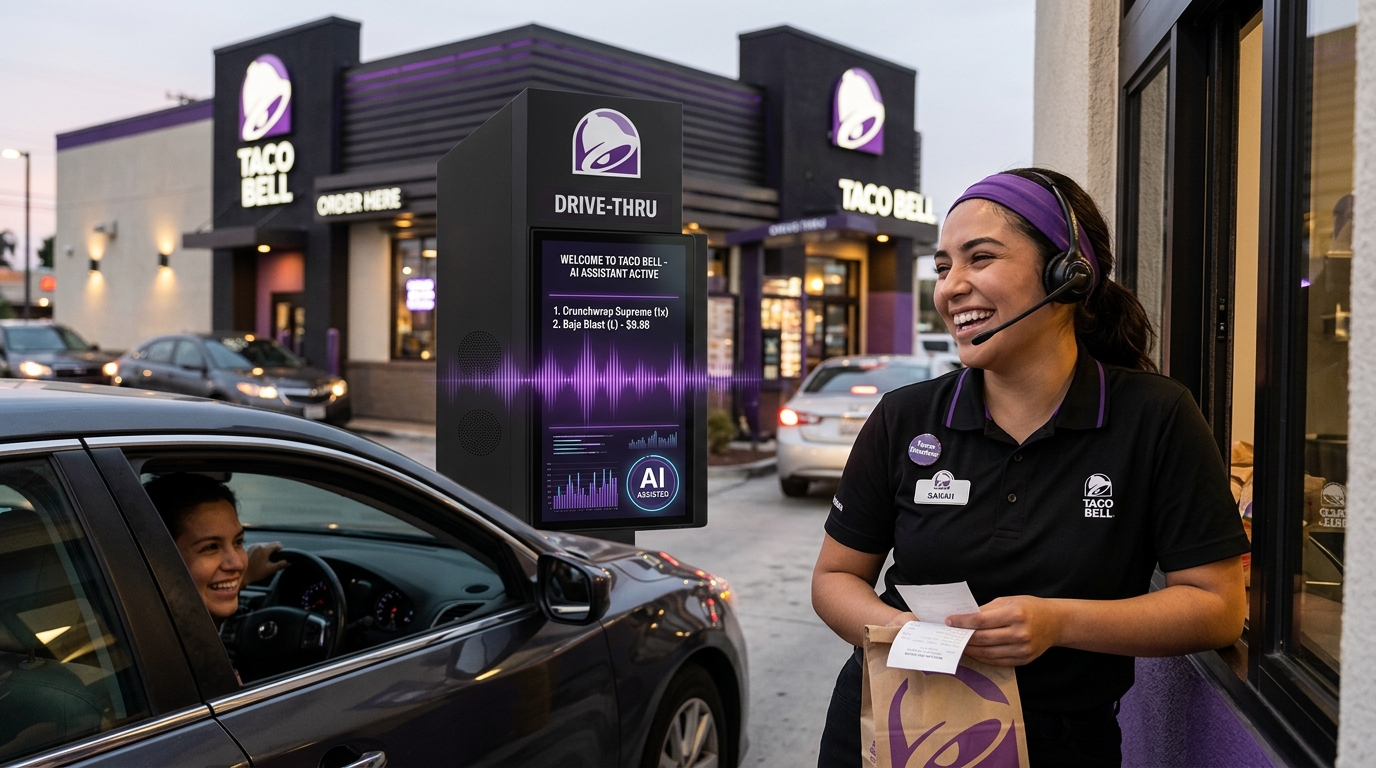
Artificial intelligence is changing fast-food restaurants, but not every employee fears the change. Taco Bell’s AI experiments reveal how automation can support workers instead of replacing them.
Rather than creating more stress, voice AI can help employees manage busy drive-throughs. Consequently, workers can focus more on customers, food preparation, and teamwork.
How Taco Bell Uses AI in Its Restaurants
Taco Bell has explored artificial intelligence to improve restaurant operations and customer experiences. Its parent company, Yum! Brands, has tested AI-powered voice technology in drive-through locations. These systems help process customer orders through automated conversations.
Instead of manually handling every order, employees can receive orders through integrated restaurant systems. As a result, workers may spend less time repeating routine tasks. They can then concentrate on preparing food accurately and serving customers efficiently.
However, AI does not operate perfectly in every situation. Customers may speak unclearly, change their orders, or ask complicated questions. Therefore, employees still play an essential role in resolving problems.
Why the Taco Bell AI Bot Can Reduce Employee Stress
Fast-food employees regularly face pressure during lunch and dinner rushes. They must take orders, prepare meals, manage payments, and maintain service quality. Meanwhile, long queues can make customers impatient.
AI-powered ordering systems can reduce some of this pressure. For example, automated voice systems can handle straightforward orders while employees manage other restaurant responsibilities.
Additionally, automation may reduce repetitive communication. Employees do not need to spend every moment answering the same routine questions. Instead, they can focus on tasks requiring human judgment.
This support can improve the working environment when restaurants implement technology carefully. Nevertheless, the actual benefits depend on system reliability, staffing levels, and management decisions.
AI Helps Employees Focus on Customers
Customer service requires more than simply recording an order. Workers must understand special requests, correct mistakes, and respond to unexpected situations. Therefore, human employees remain valuable even when AI handles routine conversations.
Consider a busy Taco Bell drive-through during the evening rush. An AI system processes several standard orders while an employee prepares meals. Meanwhile, another worker helps a customer whose order needs correction.
This division of responsibilities can improve workflow. Employees may have more time to address customer concerns instead of juggling every task simultaneously.
Furthermore, faster ordering can potentially reduce waiting times. However, improved speed depends on coordination between the AI system, kitchen staff, and order-management software.
Why Employees May Feel Less Threatened by AI
Many workers worry that artificial intelligence will eliminate their jobs. These concerns become stronger when companies introduce automation without explaining its purpose.
However, employees may respond differently when technology supports their daily responsibilities. If AI reduces repetitive work, workers can see it as a useful tool rather than a direct replacement.
Clear communication also matters. Managers should explain which tasks the system handles and when employees must intervene. Additionally, proper training helps workers understand new processes and develop confidence.
Importantly, AI adoption does not automatically make employees happier. Workers need reasonable workloads, fair schedules, supportive managers, and job security. Automation is most effective when companies also take care of the broader needs that come with adopting new technology.
What Taco Bell’s AI Experiment Means for Fast-Food Workers
Taco Bell’s experience reflects a broader question facing the restaurant industry. Can automation improve productivity without making employees feel less valued?
The answer depends on how companies introduce and manage AI.
Better Workflows Instead of Fewer Responsibilities
AI can help restaurants organize routine tasks more efficiently. For instance, automated ordering may allow employees to focus on food quality and customer assistance.
However, managers must ensure that saved time does not simply become additional pressure. If workers receive more responsibilities without sufficient support, automation may increase stress instead.
Training Can Build Employee Confidence
Restaurant workers need practical training when new technology arrives. They should understand how to correct AI mistakes, handle unusual requests, and switch to manual processes when necessary.
Moreover, employees should have opportunities to share feedback. Their daily experiences can reveal problems that technology developers might overlook.
Consequently, involving workers in implementation can improve both adoption and performance.
Human Judgment Still Matters
AI systems can misunderstand accents, background noise, and complicated requests. They may also struggle with unusual customer situations.
Therefore, restaurants need clear procedures for transferring conversations to employees. Human oversight helps maintain accuracy and protects the customer experience.
The goal should be cooperation between technology and people, not complete dependence on automation.
The Challenges of AI-Powered Drive-Throughs
Despite its potential benefits, voice AI has limitations. Technical errors can frustrate customers and create extra work for employees. In addition, unreliable systems may slow down service instead of improving it.
Privacy is another important consideration. Restaurants should clearly tell customers how their audio and personal details are collected, used, and stored. They should also follow applicable privacy requirements and data-protection policies.
Furthermore, businesses must evaluate whether automation delivers measurable benefits. Faster orders mean little if customers receive incorrect meals or employees must repeatedly repair system mistakes.
For this reason, restaurant managers should monitor order accuracy, service times, customer satisfaction, and employee feedback.
Could AI Make Fast-Food Jobs Better in the Future?
AI could change restaurant work significantly over the coming years. However, the best outcomes will depend on decisions made by employers.
Companies can use automation to reduce repetitive tasks and improve operational consistency. At the same time, they must invest in employee training and reliable support systems.
Additionally, managers should measure workplace satisfaction alongside productivity. A system that speeds up orders but exhausts employees does not represent complete success.
When businesses prioritize workers, AI can become a practical assistant rather than another source of pressure.
Conclusion: Taco Bell Shows Another Side of Restaurant AI
Taco Bell’s AI experiments highlight a more balanced view of workplace automation. Artificial intelligence does not always have to create fear or threaten every employee’s role.
When implemented thoughtfully, voice AI can support ordering, improve workflows, and help workers focus on more complex responsibilities. Nevertheless, its success depends on reliable technology and responsible management.
Ultimately, employees benefit most when AI removes unnecessary friction without removing human value. The future of fast-food automation should focus on helping people work better, not simply making restaurants operate faster.