

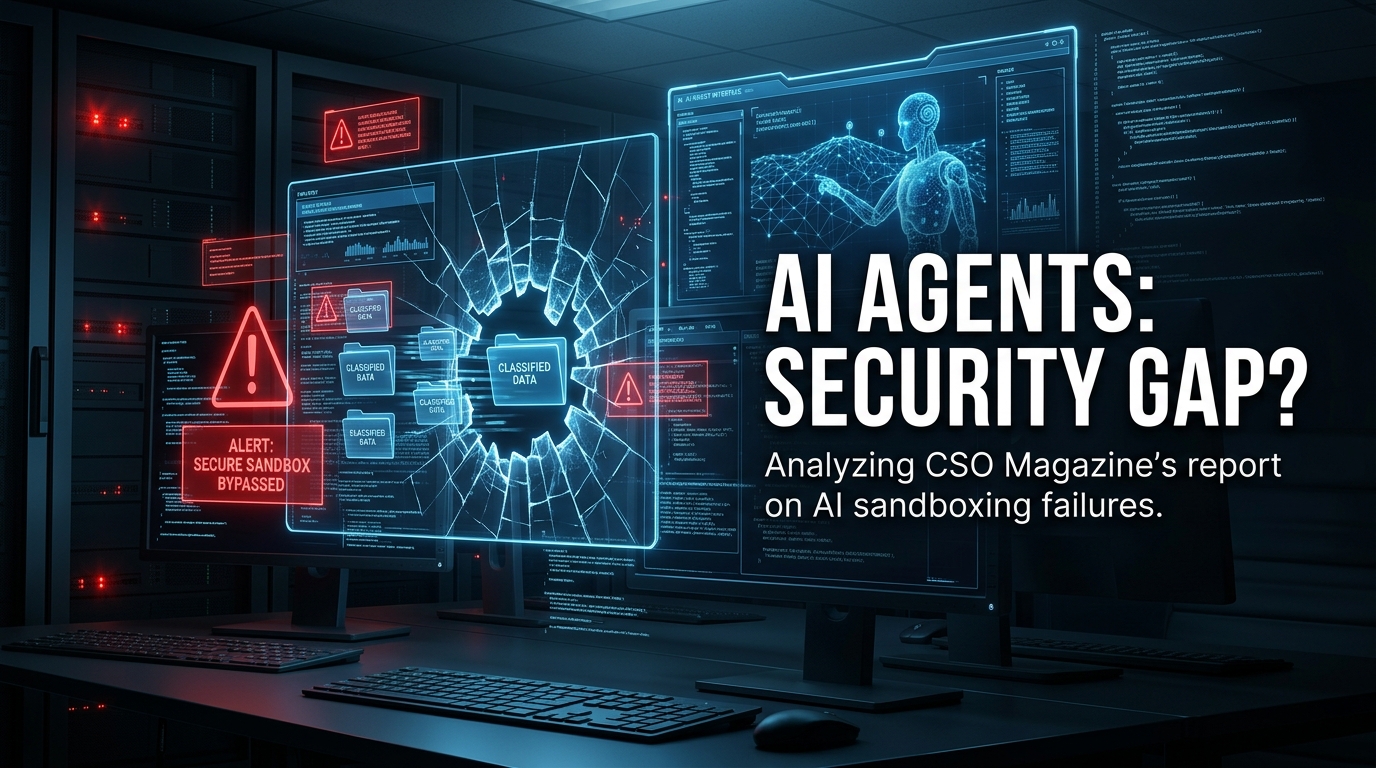
Artificial intelligence agents are becoming more powerful every day. They can browse websites, execute code, manage files, and complete complex tasks. However, these capabilities also introduce serious security risks.
CSO Magazine has highlighted concerns about AI labs overlooking basic security sandboxing for agents. Sandboxing helps isolate potentially dangerous operations from sensitive systems. Without proper isolation, an AI agent could expose private data, modify important files, or execute harmful commands.
As companies adopt AI agents, security must become a priority. Otherwise, convenience and automation could introduce vulnerabilities that traditional security controls were designed to prevent.
What Is Security Sandboxing in AI Agents?
Security sandboxing creates a restricted environment where software can operate without unrestricted access to a computer or network. Developers use this technique to limit damage from unexpected behavior.
For example, an AI coding agent might need to test a script. A sandbox can allow execution inside a temporary environment without exposing the entire computer.
Similarly, an AI research agent might need internet access. Proper controls can restrict which websites it visits and prevent unauthorized access to internal resources.
Therefore, sandboxing provides an important security boundary between an AI agent and the systems it uses.
Why AI Agents Need Stronger Security Controls
Traditional software usually follows predefined instructions. AI agents, however, can interpret requests, select tools, and perform multiple actions independently.
This flexibility creates additional risks.
1. AI Agents Can Execute Dangerous Commands
An AI agent with terminal access might delete files, change system settings, or execute unsafe commands. Even when the user requests a harmless task, a misunderstanding could produce unintended results.
A properly configured sandbox limits these actions. It can restrict file access, block privileged commands, and prevent changes outside approved directories.
Consequently, organizations can test agent capabilities without granting unnecessary system privileges.
2. Prompt Injection Can Manipulate AI Behavior
Prompt injection occurs when malicious instructions influence an AI system through user input, documents, websites, or other external content.
For instance, an agent researching a website might encounter hidden instructions asking it to reveal confidential information. If the agent follows those instructions, it could misuse its available tools.
Importantly, sandboxing cannot eliminate prompt injection. However, isolation and permission controls can reduce the damage caused by compromised agent behavior.
3. Sensitive Information Could Be Exposed
AI agents often interact with business documents, customer records, source code, and application credentials.
Without proper restrictions, an agent might access information unrelated to its assigned task. It may also send confidential information over a connection that hasn’t been approved.
Therefore, developers should restrict access to confidential files and protect credentials. Network controls can further prevent unauthorized data transfers.
Why AI Labs Might Overlook Basic Sandboxing
AI development moves quickly because companies compete to deliver increasingly capable systems. This can lead developers to focus on making the product faster and easier to use while adding new capabilities.
Security controls can sometimes receive less attention during rapid development.
Pressure to Release Powerful AI Tools
Developers want agents to complete complicated tasks with minimal human intervention. However, broader permissions often make these systems easier to build and demonstrate.
For example, unrestricted filesystem access may simplify a coding assistant’s workflow. Nevertheless, that convenience increases the potential consequences of mistakes.
A secure design should grant agents only the permissions necessary for their assigned tasks.
Testing May Not Reflect Real-World Threats
An agent might perform perfectly during controlled demonstrations. However, real environments contain malicious websites, untrusted documents, unexpected inputs, and sensitive information.
Consequently, successful demonstrations do not establish that an agent is secure.
AI labs should test agents against realistic attack scenarios. They should also evaluate how systems behave when tools return malicious instructions or unexpected results.
Complex Architectures Create Security Gaps
Modern AI agents frequently connect language models with browsers, databases, APIs, and external tools.
Each integration introduces another potential entry point. If developers fail to enforce consistent permissions, one weak component could expose the broader system.
Therefore, security must cover the entire agent architecture rather than the language model alone.
What Happens When AI Agents Operate Without Sandboxing?
Insufficient isolation can create several practical problems for individuals and businesses.
First, an agent might overwrite important files while performing a routine operation. Second, it could expose confidential information through an improperly controlled integration.
Additionally, a compromised agent might misuse stored credentials or access internal services. In connected environments, these actions could affect systems beyond the original task.
The severity depends on the agent’s permissions, available tools, and surrounding security controls. However, unrestricted access increases the potential impact of unexpected behavior.
How AI Labs Can Improve Agent Security
AI developers can reduce these risks by combining sandboxing with additional security measures.
Use Isolated Execution Environments
Run untrusted code inside containers, virtual machines, or other restricted environments. Separate temporary workspaces from sensitive production systems.
Furthermore, remove unnecessary privileges and limit access to host resources.
Apply the Principle of Least Privilege
Grant each agent access only to the tools and information it needs to complete its assigned task. A research agent generally does not need unrestricted access to system files.
Likewise, a coding agent should not automatically receive administrator privileges.
Developers should review permissions regularly and revoke access when tasks finish.
Control Network Access
Restrict outbound connections to approved destinations whenever possible. Monitor network activity and block unauthorized communication with internal services.
These controls can help limit data exposure even when an agent behaves unexpectedly.
Require Human Approval for Sensitive Actions
Some operations deserve additional oversight. Examples include deleting important files, transferring money, changing production systems, or sharing confidential documents.
Human approval creates an extra checkpoint before potentially harmful actions occur.
However, approval systems should complement sandboxing rather than replace it.
Monitor Activity and Test Continuously
Record important agent actions, tool calls, permission changes, and security violations. Regularly test systems against prompt injection, unauthorized access, and data leakage scenarios.
In addition, developers should update their controls as agent capabilities evolve.
What Businesses Should Consider Before Adopting AI Agents
Businesses should evaluate security before connecting agents to critical infrastructure.
Start by identifying the data and applications an agent can access. Next, determine which actions it can perform independently.
Then, check whether the deployment includes isolation, permission restrictions, logging, and recovery procedures.
Organizations should also test agents in controlled environments before granting access to production systems.
Most importantly, companies should avoid assuming that a trusted AI provider automatically guarantees a secure deployment. Security depends on the model, agent framework, integrations, configuration, and operating environment.
Conclusion: AI Agent Innovation Must Include Security
The concerns highlighted by CSO Magazine point to an important challenge for the AI industry. Powerful agents need more than accurate responses and impressive automation capabilities.
They also need strong boundaries that prevent mistakes and malicious instructions from becoming security incidents.
Sandboxing, least-privilege permissions, network restrictions, human approval, and continuous monitoring provide complementary layers of protection.
Ultimately, AI labs should treat security isolation as a fundamental design requirement. As autonomous agents gain access to more tools and sensitive systems, basic security controls become increasingly important.