

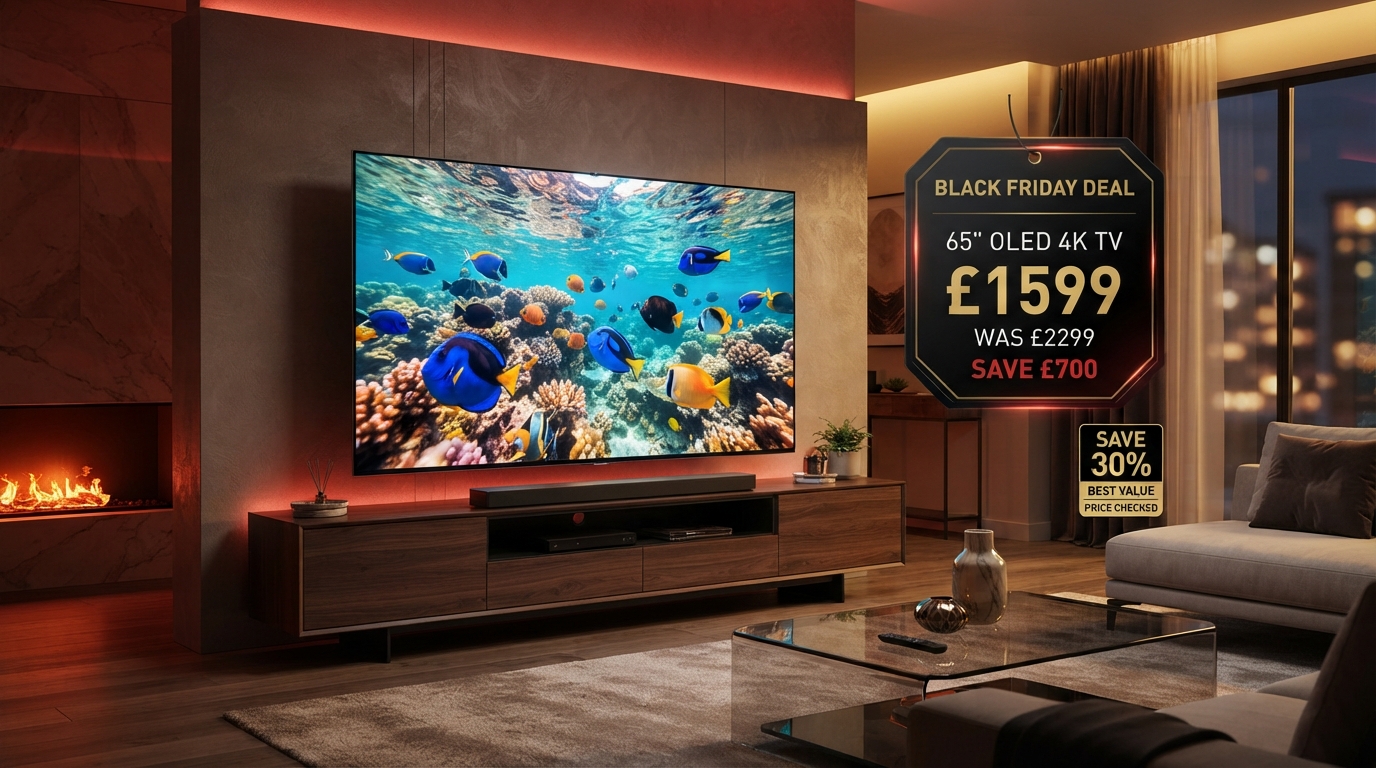
Black Friday has become one of the biggest shopping opportunities for people planning to upgrade their home entertainment systems. Television manufacturers and retailers use this shopping season to attract customers with lower prices, promotional bundles, and limited-time offers.
You may see a 55-inch television advertised at a surprisingly low price or a premium OLED model promoted with hundreds of dollars in savings. These offers can make buying a new television feel like an opportunity you should not miss.
However, the real challenge is separating genuine savings from marketing tactics that encourage people to spend money quickly.
In 2026, Black Friday falls on November 27, although many retailers have already started offering holiday promotions. Some deals may continue through Cyber Monday on November 30. This extended shopping period gives consumers more opportunities to compare products instead of making a rushed decision on a single day.
According to current Black Friday shopping coverage, early promotions can sometimes match or even beat prices available on the main shopping day.
Therefore, you should focus on the actual television, its specifications, and its historical price rather than assuming every Black Friday promotion represents an exceptional bargain.
1. Check the TV’s Real Price History
One of the smartest ways to evaluate a Black Friday television deal is to investigate how much the product has cost over the previous several months. Retailers frequently advertise large percentage discounts to make their offers look more attractive. For example, a television might have a listed original price of $1,200 and a Black Friday price of $799. The advertisement suggests that you are saving $401, but that calculation does not automatically prove the television is worth $799. If the same model regularly sold for $829 before the holiday season, the actual discount is much smaller than the advertisement suggests.
Price history gives you a more realistic picture of a product’s value. Before purchasing, search for the exact television model and examine its previous prices. Look for repeated discounts, previous promotional periods, and the lowest price recorded during the year. Consumer-focused research has repeatedly highlighted why advertised original prices can be misleading. Which? reported that its investigation of 1,617 televisions across four major retailers found that 56% had at least one intervening price between the advertised previous price and the sale price.
Which?
This demonstrates why checking the real selling price is more useful than trusting a large discount label.
Compare Prices Across Multiple Retailers
Never assume that the first retailer offering a Black Friday discount has the cheapest television. Open several trusted shopping websites and search for the exact model number. Compare the listed prices, delivery charges, installation costs, and included accessories. Sometimes one retailer offers a lower television price but charges more for delivery, while another includes free shipping or an additional warranty. These small differences can change the overall value of the purchase.
Price comparison websites and shopping tools can make this process easier. Google Shopping can help identify competing listings, while CamelCamelCamel is useful for checking historical Amazon prices. You can also check retailer websites directly to confirm whether the advertised product is actually available. Make sure that every listing refers to the same model rather than a television with a similar name but different specifications. A $50 saving is not necessarily worth choosing a weaker version of the television.
Watch Out for Inflated Original Prices
A large discount percentage can influence your decision even when the final price is not particularly attractive. Retailers understand that shoppers often respond emotionally to phrases such as limited-time offer, lowest price ever, and save 50%. These promotional messages create urgency and can make people overlook important details.
Instead of focusing on the amount supposedly removed from the original price, ask yourself what you would reasonably pay for that television. Consider its performance, specifications, reliability, and current market price. If a television costs $900 after a claimed $500 discount but comparable models sell for $850, the advertised saving is not especially impressive. Your goal should be to purchase a good television at a competitive price, not to win a competition for the biggest discount.
2. Understand What Makes a TV Worth Buying
A television’s value depends on more than its screen size and advertised price. Two 65-inch televisions can look similar in a retailer’s product listing but deliver completely different viewing experiences. One may offer better contrast, smoother motion, improved brightness, and stronger gaming support. The other might have a basic display panel, limited connectivity, and software that becomes frustrating after a few months.
Before comparing Black Friday deals, identify the features that matter most to you. Think about how you normally use your television. Do you primarily watch movies, sports, streaming services, or regular television channels? Perhaps you want a large screen for family entertainment or a television that works particularly well with a PlayStation or Xbox. Your answers will help you identify which specifications deserve attention and which premium features you can comfortably ignore.
Resolution and Screen Size
Screen resolution determines how many pixels a television uses to create an image. Most modern television shoppers should consider 4K resolution because it provides considerably more detail than older Full HD displays. A 4K television contains approximately 8.3 million pixels, creating a sharper image when viewing compatible content. This can make a noticeable difference on larger screens, particularly when sitting relatively close to the television.
However, buying the largest available television is not always the smartest decision. Screen size should match your room dimensions and viewing distance. A 75-inch TV can suit a spacious living room, yet may seem overwhelming in a compact bedroom. Similarly, purchasing a smaller screen simply because it has a bigger discount can leave you disappointed if it does not suit your entertainment space.
Consider these general guidelines when comparing screen sizes:
| Screen size | Common use | What to consider |
| 32–43 inches | Bedrooms and smaller rooms | Space-saving and budget-friendly |
| 48–55 inches | Apartments and medium-sized rooms | Good balance of size and price |
| 65 inches | Family living rooms | Immersive movie and sports viewing |
| 75–85 inches | Large entertainment spaces | Requires suitable viewing distance |
| 90 inches and above | Dedicated entertainment rooms | Space, installation, and higher costs |
Use these suggestions as a helpful guide, not as hard-and-fast requirements. Your seating distance, room layout, and personal preferences should determine the final screen size.
OLED, QLED, Mini-LED, and LED Technology
Display technology is another major factor that determines whether a Black Friday TV deal deserves your attention. Retailers frequently use terms such as OLED, QLED, and Mini-LED in their advertisements, but these technologies offer different advantages.
OLED televisions use self-emissive pixels, meaning each pixel produces its own light. Individual pixels can switch off completely, creating deep blacks and excellent contrast. This makes OLED particularly attractive for watching movies in darker rooms. However, OLED models can cost more than many traditional LED televisions.
QLED televisions use quantum-dot technology to improve color reproduction in LED-based displays. They can provide bright, colorful images and may offer strong value for rooms with considerable daylight.
Mini-LED televisions use much smaller backlighting elements than traditional LED models. This allows more precise control over brightness and darker areas of the picture. Depending on the implementation, Mini-LED televisions can deliver impressive HDR performance without the price of some premium OLED models.
Traditional LED televisions remain attractive for shoppers with limited budgets. They can provide perfectly acceptable picture quality for everyday viewing, although cheaper models may have weaker contrast, brightness, and viewing angles.
| Technology | Main advantage | Potential drawback |
| OLED | Excellent blacks and contrast | Often more expensive |
| QLED | Bright colors and strong brightness | Blacks depend on backlight performance |
| Mini-LED | Improved backlight control | Quality varies between models |
| Standard LED | Affordable and widely available | Usually weaker contrast on budget models |
Do not automatically choose a television because its advertisement mentions premium display technology. Check independent reviews and compare the performance of the exact model you are considering.
Refresh Rates and Gaming Features
A screen’s refresh rate indicates how often it redraws the picture each second. It is usually measured in hertz (Hz). A 60Hz television refreshes its image 60 times per second, while a 120Hz television can refresh it 120 times per second. Higher refresh rates can provide smoother motion, especially during fast sports broadcasts and compatible video games.
If you play games on a PlayStation 5 or Xbox Series X, check whether the television supports HDMI 2.1, 4K at 120Hz, and Variable Refresh Rate (VRR). These features can improve responsiveness and reduce visual interruptions during gameplay. Auto Low Latency Mode (ALLM) is another useful feature because it can automatically activate a lower-latency gaming setting.
For someone who mainly watches television programs and movies, paying extra for every gaming feature may not make financial sense. A good 60Hz television could be sufficient for everyday entertainment. The important thing is to avoid paying for features you will rarely use.
3. Calculate the Actual Discount
Once you understand the television’s specifications and normal selling price, calculate the actual discount. This simple exercise can prevent you from making an expensive purchase based on misleading advertising.
For example, imagine a store listing a 65-inch 4K TV at $749. Its claimed original price is $999. The retailer promotes a $250 saving, but you discover that the television has regularly sold for $799 over the previous two months. The genuine difference between its usual selling price and the current offer is only $50.
You can calculate the discount using this formula:
Discount = Original Price – Sale Price Original Price100
For example:
\[ \frac{999-749}{999}\times100=25.03\% \]
This represents the advertised discount against the claimed original price. However, using the more realistic previous selling price of $799 produces a discount of approximately 6.26%.
| Pricing detail | Amount |
| Advertised original price | $999 |
| Current Black Friday price | $749 |
| Advertised savings | $250 |
| Previous regular selling price | $799 |
| More realistic savings | $50 |
The difference is significant. A television that appears to offer a 25% discount may actually be only slightly cheaper than its recent market price. This is why calculating savings against historical prices is more helpful than relying on promotional percentages.
4. Check the TV Model Number Carefully
One mistake shoppers frequently make is comparing televisions based only on their brand, screen size, and general product name. Manufacturers sometimes release several versions of a television within the same product family. These models can have different panels, processors, refresh rates, brightness levels, and connectivity options.
Retailers may also sell exclusive versions designed for promotional periods. These televisions can look almost identical to more expensive models but may have fewer features. That does not automatically make them poor purchases, but it means you should understand exactly what you are buying.
Check the product listing or the manufacturer’s site for the TV’s full model number. Search that number alongside the word specifications or review. Check whether the model includes the advertised refresh rate, HDR support, HDMI connections, and smart features.
For example, two Samsung 65-inch televisions might both advertise 4K resolution and smart functionality. However, one could use a basic LED panel while the other offers Mini-LED backlighting and additional gaming features. Their similar descriptions do not mean they deliver equal performance.
A few minutes spent checking the model number can save you from buying an inferior television simply because its promotional listing looks impressive.
5. Consider Smart TV Software and Features
Modern televisions are not just screens for displaying broadcast channels. They function as entertainment platforms with streaming applications, internet connectivity, voice assistants, and other smart features. The software experience can have a significant effect on how enjoyable your television remains after the initial excitement of buying it disappears.
Popular smart TV platforms include Google TV, Samsung Tizen, LG webOS, and Roku TV. Each platform offers a different interface and selection of supported applications. Before purchasing, check whether the television supports the streaming services you regularly use. Also consider how easy it is to navigate menus, change settings, and connect external devices.
Processing performance deserves attention too. Some inexpensive televisions have slower processors that make menus feel unresponsive. Applications may take longer to load, and switching between streaming services can become frustrating. Reading customer feedback and professional reviews can help you identify these problems before spending your money.
Think about software support as well. A television may have excellent hardware but become less convenient if its manufacturer provides limited updates or application support. If the smart platform does not meet your expectations, you can always consider an external streaming device, but that adds another expense.
6. Compare Warranty and Return Policies
A Black Friday deal is only attractive when the retailer provides reasonable protection after the purchase. Televisions are expensive electronic products, and problems can appear after installation. You might discover dead pixels, screen damage, connectivity problems, or a display that does not perform as advertised.
Before paying, read the warranty conditions carefully. Check how long the manufacturer covers the television and which components are included. Understand whether the retailer handles warranty claims directly or requires you to contact the manufacturer. If an extended warranty is offered, compare its price and coverage instead of automatically accepting it at checkout.
Return policies are equally important. Some promotional products have different return conditions, especially when sold through third-party marketplace sellers. Confirm the return deadline, whether the television must remain in its original packaging, and who pays for return shipping.
For a large television, returning a defective product can be complicated and expensive. A retailer with clear customer support and a practical return process may offer better overall value than a seller advertising a slightly lower price.
Also remember that warranty and consumer protection rules differ between countries. Always check the conditions that apply to your location rather than assuming another country’s return policy applies to your purchase.
7. Decide Whether You Really Need a New TV
Sometimes the best Black Friday saving comes from not buying anything. Retail promotions can create the feeling that you must upgrade your television immediately, even when your existing device works perfectly well.
Ask yourself whether your current television has genuine problems. Perhaps the screen is damaged, applications no longer receive support, the picture quality is poor, or the television is too small for your living space. These are reasonable reasons to consider an upgrade. However, replacing a perfectly functional television simply because a retailer advertises a discount may not be financially sensible.
Think about the money you could use elsewhere. A new television may require additional spending on a wall mount, soundbar, streaming device, HDMI cables, or professional installation. When you include these costs, the purchase may become significantly more expensive than the original advertisement suggests.
A practical buying decision should improve your everyday experience without creating unnecessary financial pressure. If your current television meets your needs, waiting for a more suitable upgrade can be a smarter choice than purchasing during a busy shopping season.
8. Recognize Red Flags in Black Friday Advertisements
Not every television advertisement deserves your attention. Some offers are designed to generate urgency rather than communicate the product’s real value. Learning to recognize warning signs can help you avoid poor purchases and potentially unreliable sellers.
Be careful when an advertisement displays an unusually large discount without providing a clear model number. A trustworthy product listing should explain the television’s specifications, manufacturer, warranty, and delivery conditions. If these details are missing, you may have difficulty determining what you are actually purchasing.
Another warning sign is a price that appears dramatically lower than every competing retailer. An unusually cheap offer could be a genuine clearance opportunity, but it may also involve an unreliable seller, a refurbished television advertised as new, or a misleading product listing.
Pay attention to these common warning signs:
- Unclear model information: The advertisement does not provide the complete model number.
- Unrealistic discounts: The claimed savings seem much higher than competing offers.
- Unknown sellers: The retailer has little verifiable business information or customer support.
- Hidden charges: Delivery, installation, or handling costs appear during checkout.
- Unclear warranty: The seller does not explain who provides after-sales support.
- Pressure tactics: Countdown timers and limited-stock messages discourage basic research.
Always purchase from reputable retailers or verified sellers. Check website security, payment options, contact information, and independent customer feedback. A few extra minutes of research can protect you from losing money on a disappointing purchase.
9. Find the Right TV for Your Budget
A good Black Friday purchase should match your budget and entertainment needs. Spending more does not automatically guarantee a better experience, particularly if you will not use the additional features.
Start by setting a maximum spending limit before browsing promotional offers. Decide how much you can comfortably spend without affecting essential expenses. Then divide televisions into three general categories: budget, mid-range, and premium.
| Budget category | Typical features | Best suited for |
| Budget | 4K LED, basic smart features, often 60Hz | Everyday streaming and television |
| Mid-range | QLED or Mini-LED options, better HDR, additional gaming features | Families, movies, and gaming |
| Premium | High-end OLED or Mini-LED, advanced processing and gaming support | Enthusiasts and dedicated entertainment spaces |
These categories are general buying guidelines rather than fixed price ranges. Actual prices vary by screen size, manufacturer, country, and product generation.
If you are shopping on a limited budget, focus on picture quality, reliability, and essential connectivity. A well-reviewed mid-range television may provide a better experience than an expensive model with features you never use.
If you regularly watch movies in a dark room, an OLED television might justify the additional investment. If your living room receives strong sunlight, a bright QLED or Mini-LED model may be more suitable. If you plan to game, focus on the TV’s refresh rate, HDMI ports, and input lag.
The best television is the one that meets your actual requirements at a price you can afford.
10. Use a Simple Checklist Before Purchasing
After comparing prices and specifications, take a final moment to review the television before completing your order. This step is especially useful during Black Friday because promotions can make shoppers feel pressured to purchase immediately.
A simple checklist helps you focus on the details that matter instead of getting distracted by promotional messages.
- I checked the television’s exact model number.
- I compared its price across multiple retailers.
- I reviewed its previous selling price.
- I confirmed the screen size suits my room.
- I checked the display technology and resolution.
- I verified the refresh rate and gaming features I need.
- I checked the available HDMI ports and connectivity.
- I confirmed that my preferred streaming applications are supported.
- I reviewed the warranty and return conditions.
- I calculated delivery and installation expenses.
- I checked the seller’s reputation.
- The final price fits my budget.
If you cannot confidently check these points, take more time before purchasing. A genuine Black Friday deal should still make sense after you have examined all the details.
Common Black Friday TV Shopping Mistakes
Even experienced shoppers can make mistakes when they encounter attractive television promotions. One of the biggest is choosing a television based entirely on screen size. A 75-inch television may appear more impressive than a 55-inch model, but that does not mean it has better picture quality. Panel technology, brightness, contrast, and image processing can make a much bigger difference to your viewing experience.
Another common mistake is assuming that every television with 4K resolution offers similar performance. Resolution is only one part of picture quality. Two 4K televisions can produce very different images because of their panel technology, HDR capabilities, brightness, and processing systems.
Some shoppers also overlook additional expenses. Wall mounts, soundbars, delivery, and installation can increase the total purchase price. A television that initially looks affordable may become much more expensive after adding these extras.
Finally, many people wait until the last minute to research products. By then, they may have limited time to compare specifications or read reviews. Retailers understand that urgency encourages quick decisions. Preparing a shortlist before Black Friday gives you more control and makes it easier to recognize a genuine opportunity.
Conclusion
Deciding whether a Black Friday TV deal is worth buying requires more research than simply looking at the advertised discount. A television with a massive price reduction may still offer poor value if it has outdated specifications, limited features, or a history of selling at a similar price. On the other hand, a well-reviewed television with modern display technology and a genuinely competitive price can be an excellent investment.
Start by identifying the screen size and features you actually need. Compare the television’s historical price, check its complete model number, and investigate its display technology, refresh rate, and smart platform. Do not overlook warranty coverage, delivery expenses, and return policies when calculating the final cost.
Remember that Black Friday is an opportunity to save money, not a reason to spend it unnecessarily. Whether you choose an affordable LED television or a premium OLED model, the right purchase should provide reliable performance and lasting entertainment without exceeding your budget. A genuine bargain is not the television with the biggest advertised discount; it is the television that delivers the best value for your money.
Frequently Asked Questions
1. Is Black Friday the best time to buy a new TV?
Black Friday is generally one of the strongest shopping periods for television discounts. Many retailers offer competitive prices on LED, QLED, Mini-LED, and OLED models. However, some promotions begin weeks earlier, and additional discounts may appear during Cyber Monday or when retailers clear older inventory. Compare historical prices before deciding when to purchase.
2. How much discount should I expect on a Black Friday TV?
Discounts vary depending on the television’s brand, screen size, specifications, and age. Older models may receive larger reductions as retailers clear inventory, while newer premium televisions may have smaller discounts. Instead of targeting a particular percentage, compare the current price with the television’s previous selling prices and competing models.
3. Is OLED better than QLED for Black Friday shopping?
OLED generally provides deeper blacks and excellent contrast, making it attractive for movie enthusiasts. QLED televisions can deliver strong brightness and vibrant colors, which may be beneficial in brighter rooms. Neither technology is automatically better for every buyer. Your viewing environment, budget, and entertainment preferences should guide the decision.
4. Should I buy a TV before Black Friday or wait until the actual day?
You do not necessarily need to wait until Black Friday. Retailers increasingly launch early holiday promotions, and some early offers can be competitive with prices available during the main shopping event. Check price history and return policies before purchasing. If you find a genuinely attractive deal on the exact model you want, there may be little reason to wait.
5. How can I tell whether a Black Friday TV deal is genuine?
Check the exact model number, compare prices across several retailers, and investigate the product’s historical selling price. Read independent reviews to understand its picture quality and performance. Also verify the seller’s reputation, warranty coverage, delivery charges, and return policy. These checks help you distinguish genuine savings from promotional marketing.