

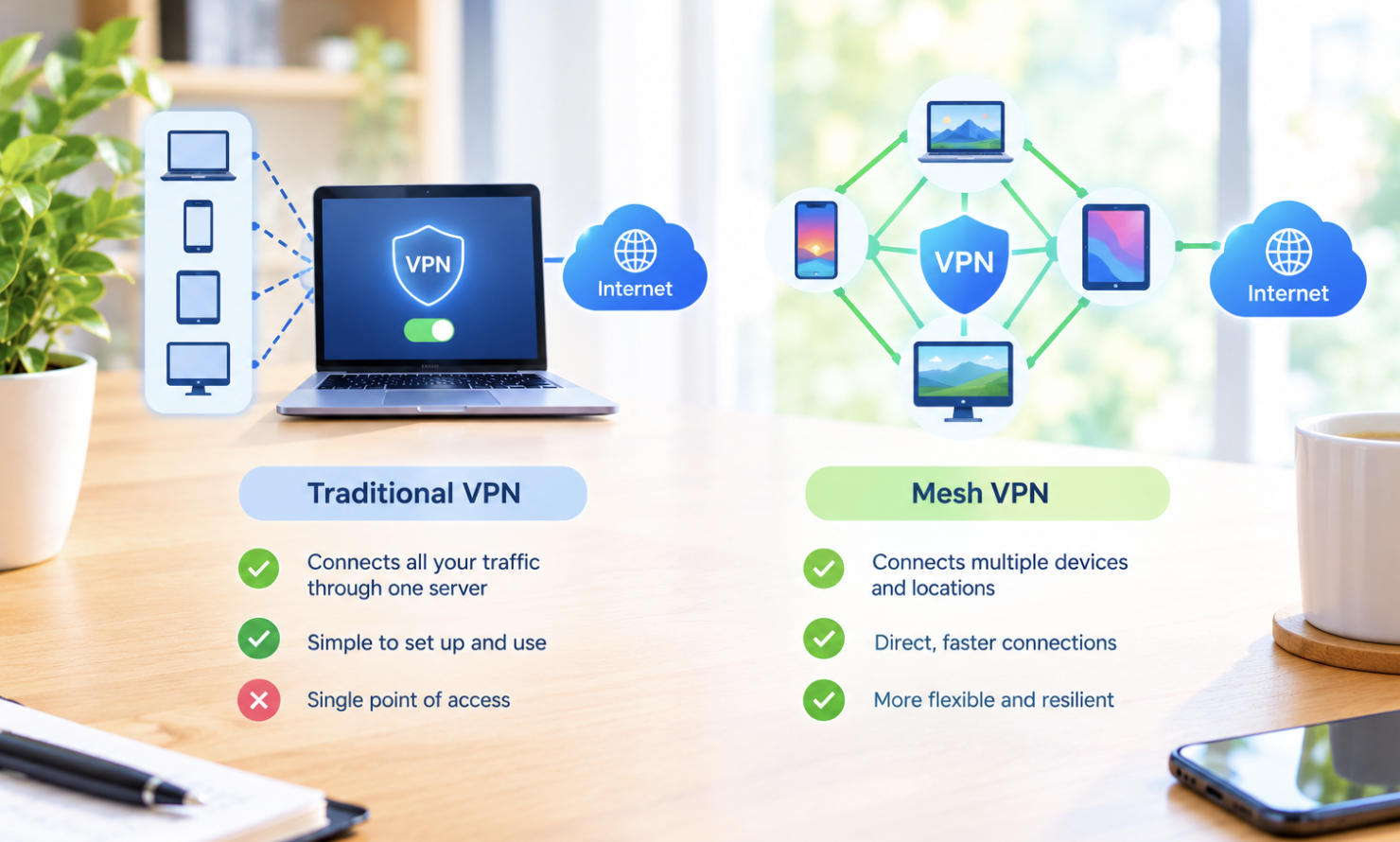
Traditional VPN services have become genuinely familiar to many internet users, yet mesh VPN technology represents a meaningfully different approach to secure networking that addresses certain genuine limitations traditional VPN architecture presents, particularly for organisations and individuals managing connections across multiple devices and locations. Understanding what a mesh VPN actually is, and how it genuinely differs from the traditional VPN approach most people already recognise, provides valuable insight into this evolving networking technology.
What a Mesh VPN Actually Means
A mesh VPN creates genuinely direct, encrypted connections between multiple devices within a network, allowing these devices to communicate with each other directly rather than routing all traffic through a single, central VPN server. This represents a fundamentally different architectural approach compared to traditional VPN services, where all your traffic genuinely travels through one central server before reaching its actual destination.
Understanding this direct, peer-to-peer connection approach genuinely matters, since it explains why mesh VPN technology can provide certain genuine advantages, particularly regarding connection speed and reliability, compared to the traditional centralised VPN model that routes all traffic through potentially distant, single-point infrastructure regardless of where the actual communicating devices happen to be located.
Understanding How Traditional VPNs Actually Work by Comparison
Understanding the traditional VPN architecture that most people already recognise helps clarify the genuine, meaningful distinction mesh VPN technology actually represents.
- Traditional VPNs route all your genuine internet traffic through a single, central VPN server
- This server then forwards your traffic toward its actual intended destination
- All communication, even between your own multiple devices, genuinely travels through this central point
- Understanding this centralised approach helps clarify what mesh VPN technology specifically changes
Understanding the Genuine Technical Advantages Mesh VPN Architecture Provides
Understanding the specific, genuine practical advantages mesh VPN architecture offers compared to traditional centralised VPN approaches helps clarify why this technology has gained genuine interest, particularly among certain user groups.
- Direct device-to-device connections can genuinely reduce the delay associated with routing through a central server
- This direct connection approach can genuinely improve performance, particularly for communication between your own devices
- Mesh VPN architecture can genuinely provide improved reliability, since no single central point represents a failure risk
- Understanding these advantages helps clarify mesh VPN technology’s particular appeal for certain networking situations
This reduced delay advantage deserves particular emphasis, since traditional VPN architecture genuinely requires your traffic to travel to the central server and then onward to its actual destination, even when communicating between two of your own devices that might be genuinely quite close to each other, while mesh VPN’s direct connection approach allows this communication to happen considerably more directly, without this often unnecessary detour through potentially distant centralised infrastructure.
Understanding Why Mesh VPNs Genuinely Suit Multi-Device Management Particularly Well
Understanding why mesh VPN technology has found particular, genuine appeal among users and organisations managing numerous devices across different locations helps clarify this technology’s particularly strong practical use case.
- Mesh VPNs genuinely simplify securely connecting numerous devices across different physical locations
- This technology allows genuinely treating geographically distributed devices as though they exist on the same local network
- Organisations with genuinely remote or distributed teams often find this capability particularly valuable
- Understanding this particular strength helps clarify why mesh VPN adoption has grown among these specific user groups
This distributed network simulation deserves particular emphasis, since mesh VPN technology genuinely allows organisations to create what functions like a single, unified private network, even when the actual devices exist across numerous different physical locations and different underlying internet connections, providing considerably more seamless, direct connectivity between these distributed resources compared to what traditional VPN architecture typically provides for this kind of genuinely distributed, multi-location networking scenario.
Understanding the Genuine Security Considerations Relevant to Mesh VPN Technology
Understanding how mesh VPN technology genuinely approaches security, given its different underlying architecture compared to traditional VPN services, helps clarify important considerations relevant to this technology’s actual protective capabilities.
- Mesh VPNs still genuinely provide encryption protecting the actual communication between connected devices
- This protection applies specifically to the direct connections established between devices within the mesh network
- Understanding your specific mesh VPN implementation’s particular security approach matters for genuine protection assessment
- This consideration helps clarify that mesh VPNs genuinely maintain core security principles despite their different architecture
Understanding the Genuine Setup Complexity Differences Between These VPN Approaches
Understanding how mesh VPN setup and configuration genuinely compares to traditional VPN services helps clarify practical considerations relevant to actually implementing this technology.
- Mesh VPN configuration can genuinely involve additional complexity compared to simpler, traditional VPN setup
- This complexity often relates to managing the genuine relationships and permissions between multiple connected devices
- Some modern mesh VPN services have genuinely worked to simplify this configuration process for typical users
- Understanding this complexity consideration helps set realistic expectations for actually implementing this technology
This configuration complexity deserves particular emphasis, since traditional VPN services often genuinely involve straightforward setup, simply connecting your device to a single provided server, while mesh VPN technology genuinely requires establishing and managing the relationships between multiple devices within your specific network, representing genuinely additional configuration consideration that, while increasingly simplified by modern service providers, still typically requires somewhat more initial setup thought compared to traditional VPN approaches.
Understanding Common Practical Applications for Mesh VPN Technology
Understanding the specific, genuine practical situations where mesh VPN technology provides particularly meaningful value helps illustrate this technology’s real-world relevance beyond simply technical interest alone.
- Remote work teams needing genuinely secure, direct connectivity between distributed team members’ devices
- Home users wanting genuinely secure access to their home network devices while away from home
- Organisations managing distributed infrastructure across genuinely multiple physical locations
- Gaming and other applications benefiting from genuinely reduced connection delay between specific devices
Understanding Whether Mesh VPN Technology Genuinely Suits Typical Individual Users
Understanding whether mesh VPN technology genuinely represents the appropriate choice for typical individual users, versus primarily suiting more specialised organisational needs, helps clarify practical guidance for this technology decision.
- Typical individual users primarily wanting basic privacy protection may find traditional VPNs genuinely sufficient
- Users specifically needing to connect and manage multiple personal devices may find genuine value in mesh VPN capability
- Understanding your own genuine specific networking needs helps clarify which approach actually suits your situation
- This personalised assessment matters more than assuming either approach represents a universally superior choice
Understanding How Mesh VPN Technology Genuinely Scales for Growing Organisations
Understanding how mesh VPN architecture genuinely accommodates organisational growth helps clarify an additional practical advantage relevant to businesses anticipating changing network needs over time.
- Adding genuinely new devices to an existing mesh network often proves more straightforward than traditional VPN expansion
- This scalability advantage genuinely matters for growing organisations regularly adding new team members or locations
- Mesh architecture’s distributed nature genuinely avoids the bottleneck a single, central server might eventually create
- Understanding this scalability helps clarify mesh VPN’s genuine appeal for organisations anticipating continued growth
Understanding the Genuine Cost Considerations Between These VPN Approaches
Understanding how the genuine ongoing costs of mesh VPN versus traditional VPN services typically compare helps clarify an additional, practical business consideration relevant to this technology choice.
- Pricing structures genuinely vary considerably between different providers and specific service tiers
- Organisations should genuinely evaluate total cost considering their specific number of devices and locations involved
- Some mesh VPN providers genuinely offer pricing models particularly well-suited to growing, multi-device organisations
- Understanding these genuine cost structures helps inform a more complete, financially informed technology decision
Final Thoughts
Mesh VPN technology creates genuinely direct, encrypted connections between multiple devices rather than routing all traffic through a single central server, providing particular advantages for connection speed, reliability, and managing distributed devices across different locations. Understanding both this technology’s genuine practical benefits and its different configuration considerations compared to traditional VPN services helps you make informed decisions about which networking approach genuinely best suits your specific personal or organisational needs.
Frequently Asked Questions
1. Does mesh VPN technology genuinely provide the same basic privacy protection as traditional VPN services?
Yes, genuinely, mesh VPNs still provide meaningful encryption and privacy protection for your connections, though the specific architecture differs from traditional VPN services, meaning the core privacy protection goal remains similar despite this different underlying technical approach.
2. Is mesh VPN technology genuinely more expensive than traditional VPN services?
This varies by specific provider and service tier, though the additional capability mesh VPN technology provides sometimes genuinely corresponds to different pricing compared to basic traditional VPN services, making direct comparison worthwhile based on your specific needs and the particular providers you are considering.
3. Can I genuinely use mesh VPN technology just for basic browsing privacy, without needing multi-device features?
Yes, technically, though if your primary need involves basic browsing privacy without requiring the multi-device connectivity mesh VPN specifically provides, a traditional VPN service may genuinely offer simpler, more straightforward functionality suited to this more basic use case.
4. Does mesh VPN technology genuinely require all connected devices to use the same specific service?
Generally yes, since mesh VPN functionality genuinely depends on all participating devices being properly configured within the same mesh network, meaning this technology typically requires consistent setup across all devices you want to include within your particular mesh VPN network.
5. How does mesh VPN technology genuinely handle situations where a specific device goes offline?
Well-designed mesh VPN systems generally genuinely continue functioning for the remaining connected devices even when one specific device temporarily disconnects, reflecting this architecture’s genuine resilience advantage compared to traditional VPN systems’ single central point of potential failure.
6. Is mesh VPN technology genuinely newer than traditional VPN technology?
The underlying networking concepts have genuinely existed for some time, though mesh VPN technology specifically designed for practical, accessible consumer and business use has seen particularly significant, genuine development and growing adoption in more recent years compared to traditional VPN services’ longer, more established history.