

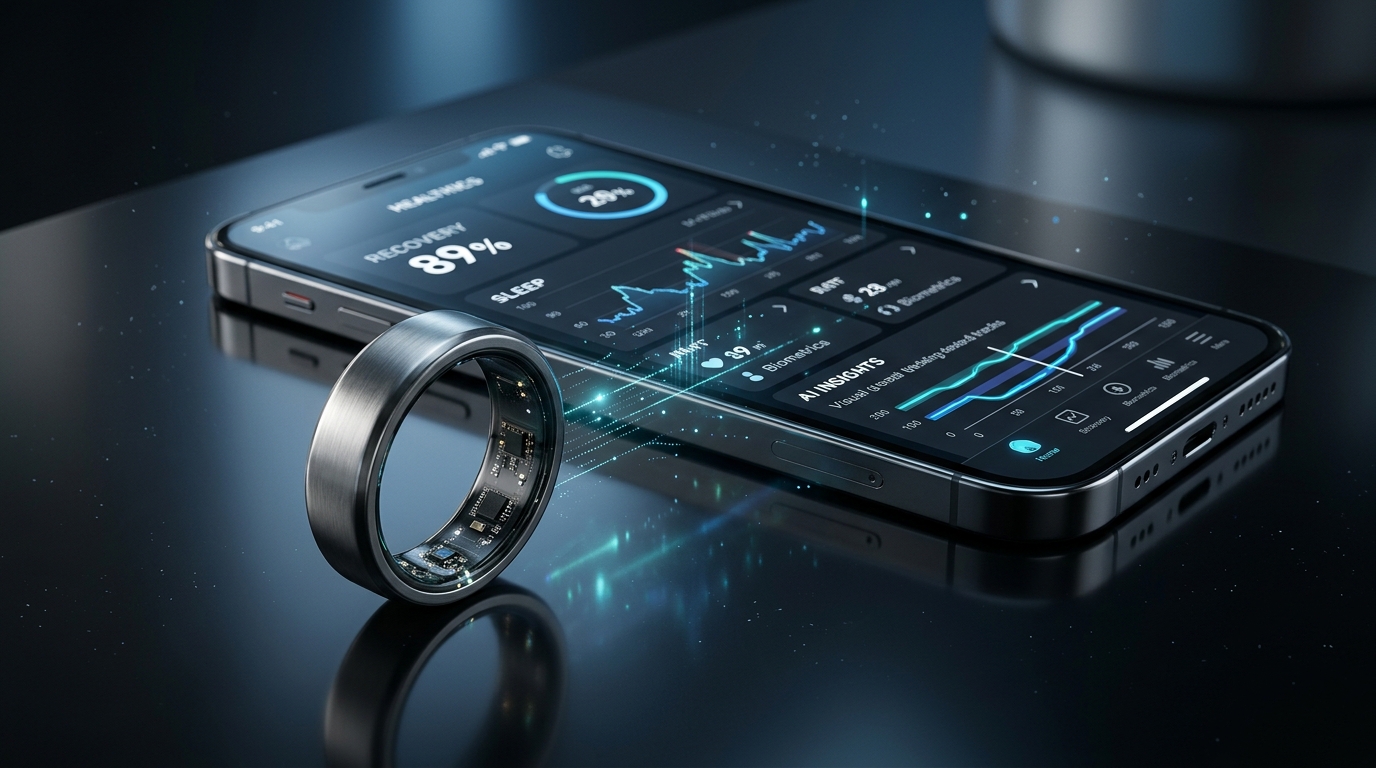
Wearable technology is moving beyond smartwatches and fitness bands. One of the most interesting developments is the AI powered smart ring, a small wearable designed to collect health and activity data continuously while remaining comfortable enough to wear throughout the day and night.
Smart rings combine miniature sensors, wireless connectivity, advanced algorithms, and increasingly sophisticated artificial intelligence. They can monitor information such as heart rate, sleep patterns, body temperature trends, blood oxygen levels, activity, and recovery. Instead of requiring users to look at a screen constantly, these devices quietly collect information and turn it into useful insights through a smartphone app.
Among the companies shaping this market, Oura has become one of the most recognizable names in smart rings. Its approach focuses heavily on sleep, recovery, readiness, and personalized health insights. The company has helped move smart rings from a niche technology product toward a mainstream health and wellness wearable.
What Is an AI Powered Smart Ring?
An AI powered smart ring is a wearable ring that uses sensors and intelligent software to collect, process, and interpret personal health and activity information.
Unlike a traditional ring, it contains extremely small electronic components. These can include optical sensors, temperature sensors, motion sensors, and other components designed to capture physiological signals.
The ring sends collected information to an application, where software analyzes patterns over time. AI can help transform raw measurements into understandable recommendations or observations.
For example, instead of simply showing changes in nighttime heart rate, an intelligent system may identify patterns associated with poor recovery, disrupted sleep, increased stress, or changes in daily activity.
This makes the technology different from simply owning a miniature fitness tracker. The goal is to provide context and personalized insights, not just a collection of numbers.
How Do AI Smart Rings Work?
An AI smart ring generally works through several connected technologies.
Miniature Health Sensors
The first component is the sensor system. Smart rings need to fit sophisticated hardware into an extremely small space.
Optical sensors can measure signals associated with heart rate and blood oxygen. Temperature sensors can detect changes in skin temperature. Accelerometers and other motion sensors help identify movement, activity, and sleep-related patterns.
Because the ring sits directly against the finger, it can collect certain measurements continuously without requiring a large screen or bulky wrist device.
Bluetooth Connectivity
The ring normally communicates with a smartphone through Bluetooth. Data collected during the day and night can be transferred to the companion application.
The ring itself does not need to display everything. This allows manufacturers to keep the physical device small and lightweight.
Artificial Intelligence and Data Analysis
This is where the “AI powered” part becomes especially important.
A smart ring can collect thousands of individual measurements, but raw data is difficult for most people to understand. Intelligent algorithms can analyze these measurements alongside historical information.
Over time, the system can establish a personal baseline and identify meaningful changes.
For example, if someone’s normal resting heart rate, sleep duration, temperature trends, and activity levels change together, software can highlight the pattern rather than forcing the user to interpret separate graphs manually.
What Can an AI Powered Smart Ring Track?
The exact capabilities vary between models, but modern smart rings can monitor several categories of health and wellness information.
Sleep
Sleep tracking is one of the strongest use cases for smart rings.
A ring can monitor movement, heart-related signals, and other measurements during the night. The accompanying application can then estimate sleep duration and identify different stages or periods of wakefulness.
More advanced systems can combine multiple signals to provide a broader picture of sleep quality.
Heart Rate
Continuous heart-rate monitoring can help users understand how their cardiovascular activity changes throughout the day and night.
Resting heart rate can also provide useful information about recovery and overall fitness trends when viewed over a longer period.
Heart Rate Variability
Heart rate variability (HRV) measures variations in the time between heartbeats. It is commonly used as one indicator associated with recovery and autonomic nervous system activity.
Smart rings can monitor HRV during suitable periods, particularly while users are resting or sleeping. Tracking trends can provide more context than looking at a single measurement.
Body Temperature Trends
Many smart rings include temperature sensors that measure changes at the skin rather than directly measuring core body temperature.
The value comes from observing changes relative to an individual’s normal pattern. Significant deviations may provide useful wellness context, although a smart ring should not be treated as a medical diagnostic device unless specifically authorized for that purpose.
Activity and Movement
Motion sensors allow smart rings to recognize activity and movement patterns.
Depending on the device and software, users may receive information about steps, activity levels, workouts, inactivity, or daily movement.
Why Oura Is Leading the Smart Ring Market
Oura has played an important role in making smart rings more visible to mainstream consumers.
The company’s strategy has centered on a relatively simple concept: collect extensive health information through a discreet ring and present the results through an easy-to-understand digital experience.
Oura Focuses on Sleep and Recovery
One of Oura’s biggest strengths is its emphasis on sleep and recovery rather than trying to replace every function of a smartwatch.
The ring can be worn overnight without the screen, notifications, and larger physical footprint associated with many wrist-based wearables.
Its software organizes information into broader concepts such as sleep, readiness, and activity. This makes the technology more approachable for people who do not want to analyze dozens of technical measurements themselves.
Personal Baselines Make the Data More Useful
A major advantage of intelligent wearable technology is personalization.
Two people can have different normal heart rates, sleep patterns, activity levels, and temperature trends. Therefore, comparing every user with the same generic benchmark may not always provide useful information.
Oura’s approach emphasizes individual trends and personal baselines. As more data is collected, the software can build a better understanding of what is normal for the individual wearer.
This can make changes easier to recognize.
A Discreet Form Factor
Smart rings have another important advantage: they are small and discreet.
A smartwatch is highly visible and includes a screen that can encourage frequent checking. A smart ring generally stays in the background.
For users primarily interested in passive health tracking, this can be an attractive alternative.
Oura and AI Powered Health Insights
AI becomes more valuable as wearable devices collect larger quantities of personal data.
Instead of presenting users with isolated measurements, intelligent software can search for relationships between different signals.
For example, a system could consider sleep duration, recent activity, resting heart rate, HRV, and other measurements when generating a recovery-oriented insight.
The objective is not simply to collect more data. It is to turn data into information that people can understand and act upon.
This direction could become increasingly important as wearable companies compete on software rather than hardware alone.
Smart Rings vs. Smartwatches
Smart rings and smartwatches serve overlapping but different purposes.
A smartwatch is generally better for interactive features such as notifications, calls, apps, GPS, workout controls, and displaying information directly on the wrist.
A smart ring is more focused on passive monitoring, comfort, sleep tracking, and discreet health data collection.
For some users, the two devices can complement each other. A smartwatch can handle interactive tasks while a smart ring focuses on continuous health and recovery tracking.
Benefits of an AI Powered Smart Ring
There are several reasons consumers are becoming interested in this category.
Small design: A ring can be considerably less intrusive than a larger wearable.
Continuous tracking: The device can collect information throughout the day and night.
Sleep monitoring: Smart rings are particularly convenient for overnight use.
Personalized insights: AI and algorithms can identify patterns across multiple measurements.
Long-term trends: Historical data can help users understand how habits and routines change over time.
Less screen dependence: Users can collect health information without constantly interacting with a display.
Limitations to Consider
Smart rings are not perfect.
Battery life varies between products, and some advanced features may require a subscription. Accuracy can also vary depending on the measurement, device fit, activity, and individual circumstances.
Another consideration is that health-related wearable data should be interpreted carefully. A smart ring can provide useful wellness information, but it should not automatically be considered a substitute for professional medical evaluation.
Privacy is also important because wearable devices collect highly personal information. Consumers should understand how their data is stored, processed, shared, and protected before purchasing a device.
What Is the Future of AI Smart Rings?
The smart ring market is likely to become more competitive as sensors become smaller and AI-based health analysis improves.
Future devices could become better at identifying personal patterns, providing more relevant recommendations, and connecting information from multiple health and fitness platforms.
AI may also reduce the need for users to manually interpret complicated health dashboards. Instead, wearable applications could increasingly explain what has changed, why it may matter, and which daily habits are associated with the change.
The biggest opportunity is therefore not necessarily adding more sensors. It is making the information generated by those sensors more useful, personalized, and understandable.
Is an AI Powered Smart Ring Worth It?
For people interested in sleep, recovery, activity, and long-term wellness trends, an AI powered smart ring can be an appealing wearable.
Oura has helped establish the category by combining a discreet physical design with extensive health tracking and a software experience centered around personal insights.
The strongest value of this technology comes from consistency. A single night’s data may tell users something, but weeks and months of information can reveal patterns that are much harder to notice manually.
As artificial intelligence continues to improve wearable data analysis, smart rings could become an increasingly important part of personal health and wellness technology. Oura’s continued focus on sleep, readiness, recovery, and personalized insights puts it in a strong position within this rapidly developing market.
Ultimately, the evolution of the AI smart ring is about moving from tracking everything to understanding what matters. That shift could define the next generation of wearable technology.