

Imagine using software that millions of people can inspect, improve, and reshape. That idea sounds unusual in a world dominated by major technology companies. However, it describes open source software, one of technology’s most influential concepts. You may already use open source tools every day without noticing them. Linux, Firefox, WordPress, VLC, and countless developer tools rely on open source principles. More importantly, open source reaches far beyond individual applications. It supports websites, cloud platforms, artificial intelligence, cybersecurity tools, mobile technologies, and business infrastructure.
So, what exactly makes software open source? How does its licensing work? What makes it different from proprietary software?
Most importantly, why does open source software matter so much? Let’s explore everything you need to know in simple, practical language.
What Is Open Source Software?
Open source software is software with source code available for public inspection. Depending on its license, users can study, modify, improve, and redistribute that code. The source code represents the instructions developers create to build software. Proprietary software usually keeps those instructions private. Therefore, open source creates a different relationship between developers and users.
Instead of depending entirely on one company, communities can participate in development. Developers can examine existing code and suggest improvements. However, open source does not simply mean “free software.”
Some open source projects charge for hosting, enterprise services, technical support, or additional features. The key difference involves access to source code and the freedoms provided by its license. That distinction matters when choosing software for personal or commercial use.
How Does Open Source Software Actually Work?
Open source development usually happens through collaboration. A project begins with source code maintained by one developer, a company, or a larger community. Developers can download the project and study its structure. They can also identify bugs, improve performance, or introduce new features. Most projects use platforms such as GitHub or GitLab for collaboration. Developers submit proposed changes through pull requests or similar workflows. Project maintainers then review those changes before accepting them. This review process helps maintain consistency and reduce unnecessary problems.
Furthermore, contributors can discuss proposed changes publicly before implementation. Over time, hundreds or thousands of contributors may improve the same project.
This collaborative model can produce remarkably powerful software. However, successful projects still need responsible maintainers, clear documentation, and active communities.
Understanding Open Source Licenses
An open source license defines how people can use the software. Therefore, users should never assume every open source project has identical rules. Different licenses provide different permissions and responsibilities. For example, the MIT License generally provides broad permission for reuse and modification. The Apache License 2.0 also permits broad reuse while providing additional legal protections.
Meanwhile, the GNU General Public License uses a copyleft approach. Copyleft licenses can require certain modified versions to remain available under similar licensing conditions. There are also many other open source licenses with different requirements.
Consequently, businesses should review a project’s license before incorporating its code. License compliance becomes particularly important when software enters commercial products. Ignoring licensing requirements can create legal and operational complications later.
Open Source Software vs Proprietary Software
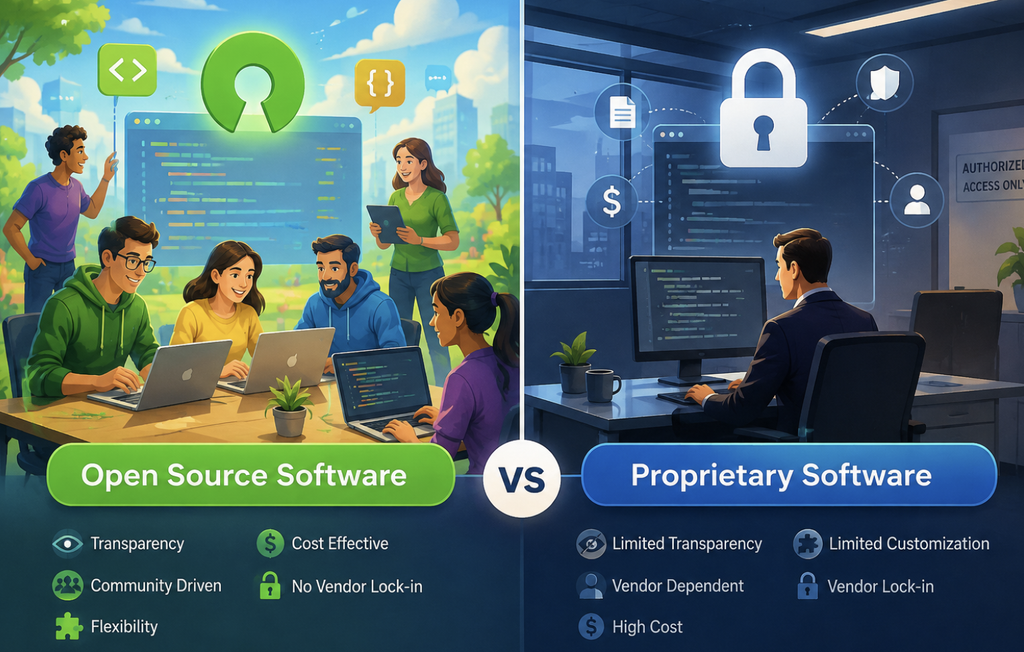
The biggest difference involves control over the source code. With open source software, authorized users can access the code under its license. With proprietary software, the company normally controls the underlying source code. Open source projects can also support greater customization. Developers can modify functionality instead of waiting for a vendor to release updates.
Proprietary software can offer another advantage through dedicated customer support. Companies may provide formal service agreements, guaranteed response times, and centralized technical assistance. Neither approach automatically wins every situation. The right choice depends on budget, technical requirements, security needs, support expectations, and long-term goals.
Why Businesses Use Open Source Software
Businesses increasingly consider open source when building flexible technology environments. First, open source can reduce traditional software licensing expenses. Companies can also customize solutions around their specific workflows. Moreover, organizations can avoid depending completely on one vendor. This advantage becomes important when pricing models or product strategies change. Open source can also support faster experimentation.
Development teams can test existing technologies without building everything from scratch. For startups, that flexibility can save both money and development time. Larger organizations can use open source components across cloud infrastructure, databases, security systems, and applications.
However, businesses still need to consider maintenance and support costs. Free licensing does not automatically mean zero operational expenses. Organizations may still pay developers, consultants, hosting providers, or enterprise support teams.
Open Source Software and Cybersecurity
Security represents one of the most discussed aspects of open source software. Public code allows researchers and developers to examine how software works. That visibility can help identify vulnerabilities before attackers exploit them. However, public visibility does not automatically make software secure. Attackers can also study publicly available code for weaknesses.
Therefore, security depends on more than simply opening the source code. Active maintenance, timely patches, secure development practices, and responsible vulnerability reporting all matter. Users should also check whether projects receive regular updates.
An abandoned project may contain unresolved vulnerabilities despite having publicly available code. For this reason, popularity alone should not determine whether software is trustworthy.
Open Source and Artificial Intelligence
Open source has become increasingly important within artificial intelligence. Developers can access open models, frameworks, libraries, datasets, and supporting tools. This accessibility encourages experimentation beyond large technology companies. Researchers can study models and build new applications around available technologies.
Furthermore, open development can improve collaboration between researchers and developers. However, “open AI” can mean different things. Some projects release model weights while keeping training data or certain development components unavailable. Others provide much broader access to their technology.
Therefore, users should examine exactly what a project makes available. The label alone does not explain the complete level of openness.
Open Source in Cloud Computing
Modern cloud infrastructure relies heavily on open source technologies. Many servers, containers, databases, networking tools, and development frameworks have open source foundations. Linux remains particularly important across server environments.
Meanwhile, technologies such as Kubernetes help organizations manage containerized applications. Open source cloud tools also allow businesses to build flexible infrastructure. That flexibility can reduce dependence on a single cloud provider.
However, organizations still need skilled teams to manage complex open source environments. Therefore, technical expertise remains an important part of successful adoption.
Popular Examples of Open Source Software
You probably recognize several open source projects already.
- Linux provides the foundation for countless servers, devices, and computing environments.
- WordPress helps individuals and organizations create websites without building everything manually.
- Mozilla Firefox offers an open source browser focused strongly on user control and privacy.
- VLC Media Player supports a wide range of multimedia formats.
- Blender provides powerful tools for 3D modeling, animation, rendering, and visual production.
- LibreOffice offers an open source alternative for common office productivity tasks.
These examples demonstrate the enormous range of open source technology. It serves beginners, developers, creative professionals, researchers, businesses, and large organizations.
Advantages of Open Source Software
Open source software offers several practical advantages.
- Lower licensing costs can make technology more accessible to individuals and organizations.
- Customization allows developers to modify software for specialized requirements.
- Transparency lets users inspect available source code and development activity.
- Community collaboration can bring together contributors from different countries and industries.
- Reduced vendor dependence gives organizations greater control over their technology choices.
- Rapid innovation can occur when developers build upon existing projects.
- Learning opportunities also make open source valuable for students and new developers.
People can study real projects instead of relying only on theoretical examples.
Potential Disadvantages of Open Source Software
Open source also comes with challenges. Some projects lack professional customer support. Others may receive fewer updates when their maintainers become inactive. Documentation quality can vary dramatically between projects.
Furthermore, certain tools require technical knowledge that beginners may not possess. Compatibility issues can also appear when projects depend on different libraries or versions. Security risks deserve attention as well.
A vulnerability can affect many applications when they rely on the same open source dependency. Therefore, organizations should monitor dependencies and apply security updates regularly.
What Is an Open Source Fork?
A fork occurs when developers create a separate version of an existing project. This can happen because contributors disagree about the project’s future direction. Sometimes, forks happen after disagreements about governance, licensing, or technical decisions. A successful fork can develop into an independent project.
However, multiple versions can sometimes confuse users. Therefore, communities need clear documentation and communication. Forks can still benefit open source development by encouraging alternative approaches and innovation.
Open Source Software and Vendor Lock-In
Vendor lock-in occurs when switching providers becomes difficult or expensive. Open source can reduce this problem by giving organizations greater access to underlying technology. For example, developers may migrate software between compatible environments more easily. They can also maintain greater control over their data and infrastructure.
However, open source does not completely eliminate lock-in. Some companies build proprietary services around open source projects. Therefore, users should evaluate the complete technology ecosystem rather than the software label alone.
How to Choose Reliable Open Source Software
Choosing an open source project requires more than checking its download count. First, examine how frequently developers maintain the project. Then, review recent releases, security notices, documentation, and community activity. You should also check the project’s license before commercial adoption.
Look for transparent development practices and clear contribution guidelines. Additionally, investigate whether organizations actively use the software. Strong community participation can indicate continued interest and development.
Finally, consider whether your team can maintain the software over time. A powerful tool becomes less useful when nobody can manage it effectively.
How Can Beginners Start Using Open Source Software?
You do not need advanced programming knowledge to explore open source. Start by trying well-established applications designed for everyday users. You can explore alternative browsers, office tools, media players, and creative applications.
Next, visit developer platforms and browse interesting projects. Read documentation before installing unfamiliar software. If you eventually learn programming, consider making small contributions.
You could fix documentation errors, report bugs, improve translations, or suggest usability improvements. Even small contributions can help a project grow.
How Can Developers Contribute to Open Source?
Developers have many ways to contribute. They can submit bug fixes, write documentation, improve tests, or develop new features. However, beginners should avoid immediately changing complex parts of large projects. Instead, start by reading contribution guidelines. Then, choose a small issue labeled for beginners.
Discuss your proposed solution when project maintainers encourage discussion. Afterward, submit a clear pull request explaining the changes. This approach helps developers learn both technical and collaborative skills.
The Future of Open Source Software in 2026
Open source continues to influence the direction of modern technology. Its role extends across artificial intelligence, cloud computing, cybersecurity, web development, and automation. Businesses increasingly value technologies that provide flexibility and reduce unnecessary restrictions.
Meanwhile, developers benefit from communities that share knowledge and reusable components. Artificial intelligence may further expand open source collaboration. Developers can experiment with models and tools without building entire systems independently.
However, licensing, security, governance, and responsible development will become increasingly important. The future will likely involve both open and proprietary technologies working together. Therefore, understanding open source provides valuable knowledge for anyone navigating the modern digital economy.
Conclusion
Open source software has changed how people create, share, and improve technology. It gives communities greater opportunities to inspect and modify software. At the same time, it can reduce costs and encourage faster innovation.
However, users must understand licenses, security risks, maintenance requirements, and project activity. The strongest open source projects combine accessible code with active communities and responsible governance.
Whether you are a student, developer, business owner, or everyday user, open source deserves attention. It is not simply a software distribution model. Instead, it represents a collaborative approach that continues shaping the technology around us.
Frequently Asked Questions
1. What is open source software?
Open source software provides publicly accessible source code under a specific license.
2. Is open source software always free?
No, some projects charge for hosting, support, enterprise features, or related services.
3. Is open source software safe?
It can be safe, but users should choose actively maintained projects and trusted sources.
4. Can businesses use open source software?
Yes, businesses can use open source software while following its specific license requirements.
5. Can I modify open source software?
Yes, most open source licenses allow modification, although specific conditions can apply.
6. What are popular open source software examples?
Linux, WordPress, Firefox, VLC, Blender, and LibreOffice are widely known examples.
7. Does open source software require coding skills?
No, many open source applications work normally without requiring users to understand programming.
8. What is an open source license?
An open source license defines how people can use, modify, and redistribute software.
9. What does vendor lock-in mean?
Vendor lock-in makes switching from one technology provider to another difficult or expensive.
10. Can developers make money from open source?
Yes, developers can earn through support, consulting, hosting, customization, and related services.
11. What is a fork in open source software?
A fork creates a separate development path from an existing open source project.
12. Why is open source important for developers?
It provides opportunities to learn, collaborate, experiment, and contribute to real-world technology.
13. Is Linux open source software?
Yes, Linux is a major open source operating system used across many computing environments.
14. How can beginners contribute to open source?
Beginners can report bugs, improve documentation, translate content, or fix simple issues.
15. Why should companies check open source licenses?
License requirements can affect how companies modify, distribute, and commercially use software.