

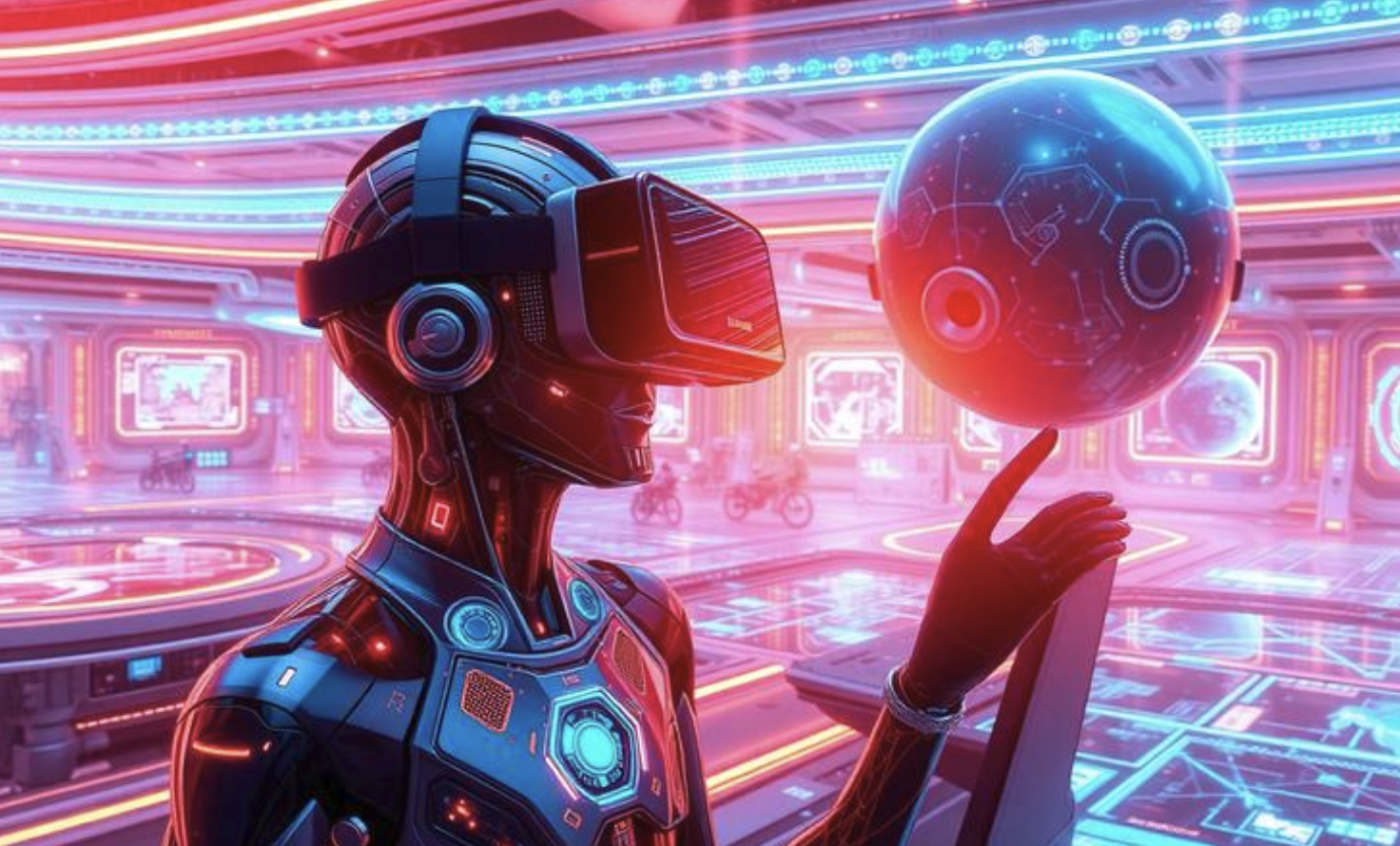
Most conversations about the metaverse focus on the hardware, the headsets, the haptic gloves, the immersive displays. But the hardware is just the doorway. What’s actually going to determine whether virtual worlds feel alive or hollow is the intelligence running underneath them. And that intelligence is artificial.
The combination of AI and the metaverse isn’t a minor upgrade to the virtual reality experiences people have experimented with over the past decade. It’s a fundamentally different proposition. A metaverse without AI is essentially a very expensive video game, beautifully rendered but static, limited to whatever its developers pre-built. A metaverse powered by AI is something closer to a living environment, one that responds, adapts, and evolves based on who’s in it and what they’re doing.
That distinction matters enormously for what these platforms can actually become.
How AI Becomes the Architecture of Virtual Worlds
The most immediate way AI changes the metaverse is in how the world itself gets built and maintained. Traditional virtual environments require developers to design and build every element manually, every building, landscape, and interaction. That process is slow, expensive, and finite. Once the developers stop building, the world stops growing.
Generative AI removes that ceiling. Algorithms can now create detailed landscapes, architectural structures, and entire ecosystems in real time, shaped by how users move through and interact with the space. A corner of the virtual world that rarely gets visited might stay quiet and underdeveloped. A district that becomes a hub of activity could grow organically, new spaces appearing, environments shifting based on community behavior. The world becomes a reflection of its inhabitants rather than a fixed stage they perform on.
This also transforms avatars. Current virtual platforms offer digital skins, you choose an appearance and that’s what you are. In an AI-driven metaverse, avatars can carry their own behavioral logic. They learn from past interactions, adjust how they communicate based on context, and develop something closer to a genuine digital personality over time. Your virtual presence stops being a costume and starts being a representation.
The Technologies Making It Work
Three specific branches of AI do most of the heavy lifting here.
Natural language processing handles communication. The non-player characters that populate virtual spaces have historically been limited to scripted responses, ask something outside the script and the illusion breaks immediately. With advanced NLP, those characters can hold open-ended conversations, pick up on context and tone, and respond in ways that feel genuinely reactive. For global communities using the metaverse to connect across language barriers, real-time translation becomes possible without any friction. Moderation tools powered by NLP can also detect harmful language patterns before they escalate, making large virtual communities significantly easier to manage.
Computer vision handles how the digital world perceives both its users and itself. On the user side, it enables realistic avatar creation from a simple scan and translates real-world gestures and facial expressions into the virtual environment, so your avatar doesn’t just stand there while you talk; it moves the way you move. Within the environment itself, computer vision gives the world an understanding of spatial relationships and object properties, enabling realistic physics and more intuitive interaction between users and the digital space around them.
Machine learning handles personalization and economics. It tracks what individual users engage with, what they skip, what kinds of social interactions they seek, and builds a picture of their preferences that shapes what they encounter in the metaverse going forward. On the economic side, and virtual economies are already significant in existing platforms, machine learning can monitor trading patterns, predict demand shifts for digital goods, and help create pricing systems that remain stable rather than swinging wildly based on speculation.
What Users Actually Experience
Strip away the technical architecture and what users encounter in an AI-powered metaverse looks quite different from anything currently available.
Entertainment stops being a passive experience. Stories adapt in real time to the choices users make, with AI characters who remember previous conversations and adjust their behavior accordingly. A virtual concert can read the energy of the crowd and shift its presentation dynamically. Games feature opponents that study how you play and evolve their approach, making repetitive strategies eventually ineffective.
Education becomes genuinely immersive. Historical environments can be reconstructed with high fidelity, guided by AI narrators that field questions and adjust the depth of explanation based on what the learner already understands. Complex scientific or engineering concepts become explorable rather than just readable.
Work gains a new dimension. Collaborative virtual workspaces allow teams in different countries to interact with the same three-dimensional environment simultaneously, reviewing architectural plans, running manufacturing simulations, or building product prototypes in a shared digital space. AI layers real-time analysis and recommendations into these sessions, making the virtual workspace more functional than a video call and, for certain tasks, more functional than being in the same physical room.
The Numbers Behind the Growth
The AI-powered metaverse is still early in its development, but the scale of investment and adoption already underway gives some indication of where it’s heading.
| Metric | Current Estimate |
|---|---|
| AI-powered metaverse platforms actively operating | 10+ major platforms |
| Global market size | Approximately $5 billion and growing |
| Virtual environments now incorporating AI features | Around 75% of new builds |
| AI algorithms typically deployed per metaverse platform | 20+ distinct models |
These figures reflect a market that has moved well past the concept stage. The infrastructure is being built now, which means the ethical and governance questions that come with it need to be addressed now as well.
The Challenges That Can’t Be Ignored
The same personalization that makes an AI metaverse compelling also makes it potentially invasive. Building an environment that adapts to your mood, your preferences, and your behavior requires collecting an enormous amount of data about you, more granular and more continuous than almost any existing platform gathers. Who holds that data, how it’s protected, and what they’re permitted to do with it are questions that current regulatory frameworks weren’t designed to answer.
Bias in AI systems is a particular concern at this scale. When AI is shaping what content you see, which social connections get suggested, and how the environment responds to you, any bias baked into the underlying models gets embedded into the user’s daily experience. Building diverse training datasets and conducting ongoing audits isn’t an academic exercise here, it’s the difference between a platform that serves everyone and one that systematically disadvantages certain groups.
Governance is the hardest problem. Who makes the rules for a dynamically generated virtual world inhabited by people from dozens of different legal jurisdictions? How do you enforce standards when the world itself is partially AI-generated and constantly changing? Neither purely centralized nor fully decentralized models have clean answers, and working out a functional approach will likely take longer than building the technology itself.
Conclusion
The AI-powered metaverse represents one of the more significant shifts in how humans will interact with digital environments over the next decade. Not because of the headsets or the graphics, but because of the intelligence underneath, the systems that make these worlds responsive, personalized, and genuinely dynamic in ways that no static virtual environment can be.
The potential is substantial. So are the responsibilities that come with it. The platforms that get this right will be the ones that treat the ethical questions with the same seriousness they bring to the technical ones. Building intelligent virtual worlds is one thing. Building ones worth inhabiting is another challenge entirely.
Frequently Asked Questions
1. What makes an AI-powered metaverse different from regular VR?
Standard VR puts you in a pre-built environment that never changes. An AI-powered metaverse adapts, the world evolves, characters respond intelligently, and your experience is shaped by your own behavior rather than a fixed developer script.
2. Are AI characters in the metaverse actually intelligent?
Not in the human sense, but far beyond traditional scripted NPCs. Advanced NLP lets them hold open-ended conversations, remember past interactions, and respond to tone, making exchanges feel genuinely natural.
3. What are the biggest privacy risks?
Deep personalization means continuous data collection about your behavior and preferences. Key risks include data breaches and manipulation. Always look for platforms with transparent data policies and strong encryption.
4. Can the metaverse be used for serious work?
Yes. Collaborative virtual workspaces and digital twins of real-world systems are already in professional use. For distributed teams, certain tasks are genuinely more effective in immersive 3D environments than over video calls.
5. When will AI-powered metaverse experiences be widely available?
Basic versions already exist. Fully realized environments with sophisticated AI behavior and deep personalization are still developing, mainstream quality access is realistically a few years away, though progress is fast.