

Understanding Climate Terms Without Confusion
Many science books present climate concepts using attractive yet misleading visuals. As a result, students often absorb simplified explanations. However, accuracy matters when discussing planetary systems. Therefore, understanding precise terminology improves scientific literacy. Moreover, correct language builds confidence in academic writing. The greenhouse effect and global warming represent distinct climate processes. Yet, educators often merge them unintentionally. Consequently, learners confuse cause with consequence.
Why Climate Vocabulary Shapes Real Understanding
The greenhouse effect describes a constant atmospheric function. In contrast, global warming reflects a recent temperature trend. Although they connect, they do not mean the same thing. Therefore, separating them clarifies climate science discussions. Additionally, accurate definitions support exam performance. Students then avoid repeating common textbook errors. As a result, essays gain authority and clarity.
The Greenhouse Effect Explained Clearly
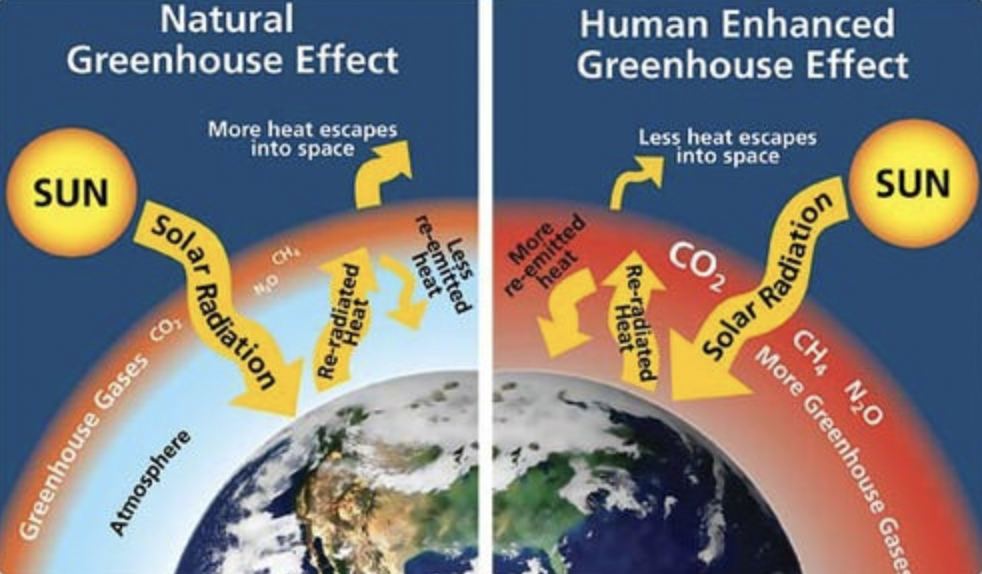
The greenhouse effect operates through energy balance. Sunlight enters Earth’s atmosphere easily. Afterward, the surface emits infrared radiation. Greenhouse gases absorb that outgoing energy. Then, they re release it in multiple directions. This process stabilizes planetary temperature. Importantly, gases never form a physical barrier. Instead, they influence radiation movement.
Why the “Thermal Blanket” Analogy Fails
Textbooks often use blanket comparisons. However, blankets block airflow directly. The atmosphere behaves differently. Greenhouse gases interact with radiation, not air movement. Therefore, the analogy oversimplifies physics. Students then misunderstand energy exchange. Consequently, misconceptions persist into higher education.
The Natural Greenhouse Effect Supports Life
The greenhouse effect sustains Earth’s habitability. Without it, temperatures would drop drastically. Oceans would freeze permanently. Likewise, ecosystems would collapse. Thus, the effect benefits life continuously. Water vapor plays a leading role here. Additionally, carbon dioxide contributes steadily. Together, these gases maintain balance.
When Balance Turns Into a Problem
Problems arise when greenhouse gases increase excessively. Human activity drives that increase. Burning fossil fuels releases additional carbon dioxide. Deforestation further reduces natural absorption. As a result, heat retention intensifies. This process defines global warming. Therefore, global warming represents amplification, not invention.
Global Warming as an Enhanced Process
Global warming accelerates natural heat retention. Industrial emissions thicken atmospheric gas concentrations. Consequently, radiation escapes less efficiently. Surface temperatures then rise steadily. Weather patterns shift accordingly. Moreover, ice melts at unprecedented rates. Thus, climate stability weakens globally.
Separating Ozone Depletion From Climate Change
Many learners confuse ozone loss with warming. However, ozone protects against ultraviolet radiation. It does not regulate infrared heat. Therefore, ozone depletion does not cause warming. Mixing these topics damages scientific accuracy. Hence, keeping atmospheric layers distinct remains essential.
Key Differences Between the Two Concepts
The greenhouse effect exists naturally. Global warming results from human influence. One maintains temperature balance. The other disrupts the equilibrium. The greenhouse effect spans billions of years. Global warming accelerated after industrialization. Both involve gases, yet in different quantities.
Why Students Must Understand This Distinction
A clear understanding strengthens climate discussions. Students then engage in debates with confidence. Moreover, accurate knowledge improves policy conversations. Education shapes informed citizenship. Therefore, climate clarity holds long-term value. Understanding physics empowers responsible decision-making.
Preparing for Advanced Science Learning
College level science demands precision. Simplistic models no longer suffice. Thus, students must challenge outdated explanations. Learning correct mechanisms improves analytical skills. Consequently, academic performance improves naturally.
Final Perspective on Climate Science
The greenhouse effect represents atmospheric harmony. Global warming reflects an imbalance driven by excess. Both concepts deserve separate treatment. Clear distinction enhances comprehension. Ultimately, informed understanding supports future solutions. Scientific clarity remains essential for global progress.